
Gabriella Rouf
LOUDERS AND FUNNIERS
ITALIAN OBSERVATORY
Translation by Giorgio La Rocca
Wodehouse fans, never tired of reading and rereading it, extend their pleasure in repertoires and bibliographies, for narrative cycles, characters, quotes. In the context of contemporary barbarism, while literary heritage is attacked and disfigured by deformations, banalizations and censures, these spaces of enjoyment elegantly escape from totalitarian moralism: Wodehouse, in punctual foreboding symmetry to the politically correct, opposes a smooth surface, impenetrable to the acids of post-human conceptualism; tells the integral and frank human in a modern fairy tale, tougher and more irreducible than the, today massacred, ancient fables.
The Wodehouse magnet attracts around itself, by more or less random ways and chronological suggestions, other readings, similar for inspiration, wisdom and irony. It is he who invites to this game, through the use of quotes and references, by the voice of the author or his characters — Bertie but especially Jeeves —, in a stylistic note that goes beyond the immediate ironic effect: calls to rally, calls for reinforcement, evokes traditions, legacies and philosophical and literary, human witnesses.
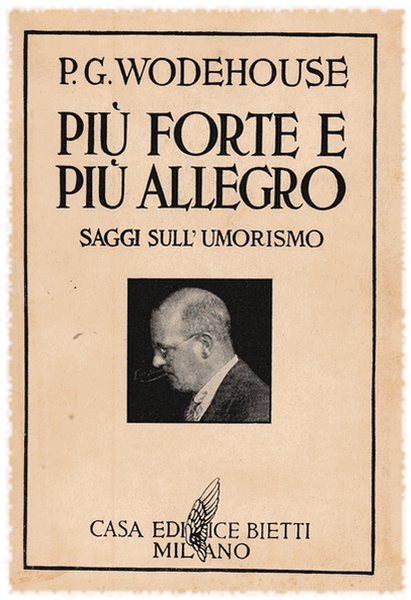
In 1932 Wodehouse published in Louder and Funnier (translated in Italian in the same year by Alberto Tedeschi for Bietti as Più forte e più allegro) a selection of articles published from 1914 to 1923 on Vanity Fair. The author in the foreword justified the title with
the old story [...] of the one who had to give a speech after a lunch and was very nervous. Like many others in his case, he had begun to speak in a low and hesitant voice. After a while the usual stern voice said: ! — Louder, please! —. A few minutes later another voice observed: — Louder, please... and funnier! —
“Loud and fun” is a surprisingly up-to-date reading key, in the face of the “weak and gloomy” that proliferates on the net, bookstores, prizes and literary fairs. For further comfort, Wodehouse invites you to the game of meetings and recalls, which everyone can do on each of his works, as its specialists and readers also do, even in rich dedicated sites.
Joy and irony, are a form in which the human being expresses the consciousness of existence, that in “being in common”, in frank and concrete communication finds joy, empathy, moral and intellectual strength. Humour is not an escape, but rather it is an immanent sign of the human being conscious of its power and its limits: loud and cheerful. The ideology that aspires to the mineralization of reality, to the posthuman, is the point of no return, the nemesis of individualism alienated in ideologies.

The code of Wodehouse.
Years ago, the BBC did an international survey among literary critics for a score ranking of quality of English novels. Wodehouse appeared in the 100th place with The Code of the Woosters (1938, published in Italy the following year as Jeeves non si smentisce, always with translation by Alberto Tedeschi). Beyond the question of the ranking, it draws attention to a novel that can be considered representative not only for its title and the interweaving of recurring motifs and characters, but also for a particularly rich “game” of quotes: you go from Jaufré Rudel to Leigh Hunt to Shelley, from Sherlock Holmes to Poirot to The Trial of Mary Dugan, from Maurice Chevalier to Robert Taylor to Guglielmo Marconi.
On every novel or collection of short stories by Plum, you can enjoy this game, which is not a superfetation or pedantry on the text, but a kind of aura, projection of effects and echoes. Associations, blogs, English, American, Indian sites... on Wodehouse, they all testify to a passion, of a curiosity, that while it preserves (and protects) the wodehousian canon, exposes its correct reading, non-conceptual, irreducible to aesthetic or moralistic commonplaces. The web model is www.madameulalie.org.
The “code of Wodehouse” is enough to itself, it’s a self-sufficient universe; if in the past it fell into disgrace because considered frivolous, not “engaged”, or sexophobic or misogynistic etc... Today it has the power and prestige to keep away from the so-called “revaluations” which in his work “discover” social criticism, satire against the aristocracy, the capitalism, denunciation of hypocrisy, of machismo, or intervene with de-structuring social and psychological conceptualizations.
Thriller!
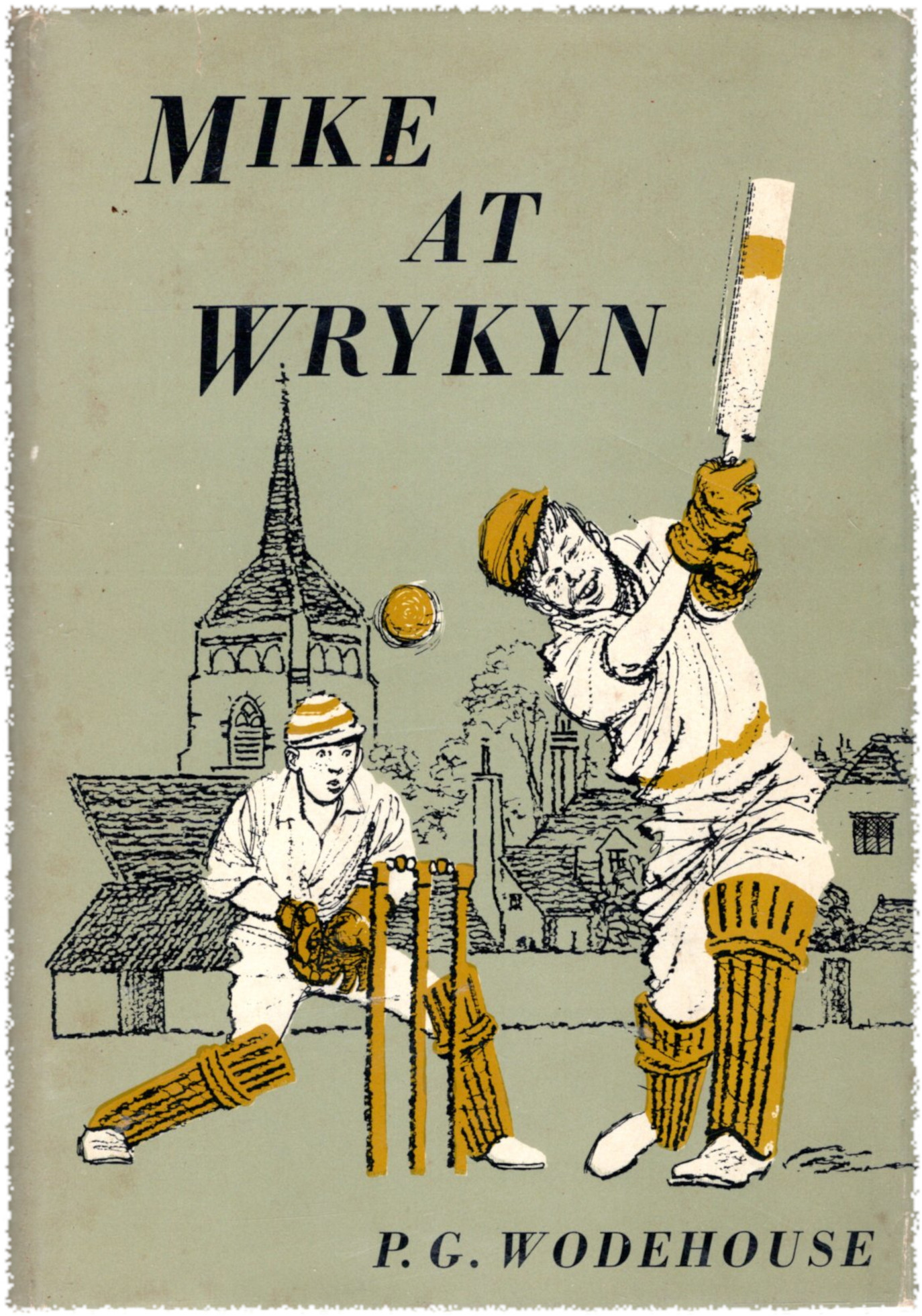
An article from Louder and Funnier is dedicated to thrillers and crime novels. In the early years’ stories1 Wodehouse had experienced similar plots, in college and cricket stories, but here he wittily distances himself from a fad that he likens to an epidemic of plague or flood on the British Isles. Follows an hilarious description of the plot-type, with love story, heroine in danger, and criminal inept, doomed to failure in his tempting ventures. Lists as exceptions in this trite panorama Dorothy Sayers, Anthony Berkeley, Philip MacDonald, H.G. Bailey, Agatha Christie and Edgar Wallace. At this point Wodehouse offers the advice that he would give to a careless son who wanted to pursue a career as an author of mystery books, to the paradox that the only new and original idea would be that the murderer was a character never appeared and mentioned in the book, because all other variants have already been exploited:
The stock of the assassins is disappearing, you see? All have been used too often. You can’t be any more certain of the detective’s friend. Since the release of Agatha Christie’s book Roger Ackroyd, we have been watching that friend closely. Dr Watson is very lucky to belong to the pre-Christie era!
In Cards on the Table (1939) Agatha Christie inserts a monologue of the character of Ariadne Oliver (parody of herself and the many female writers of mystery novels) which seems to be the continuation of Wodehouse’s text on the thrillers: the tricks of the trade, the clichés about detectives and murderers, the heroines in danger and the yellow-pink plot. Lady Agatha could afford this self-irony because she had experienced the most daring variations. If in the quoted The murder of Roger Ackroyd (1926) the murderer is just the narrator, friendly and in cordial relations with the investigator Poirot, in the extreme case, in Murder on the Orient Express (1934) the killers are all!
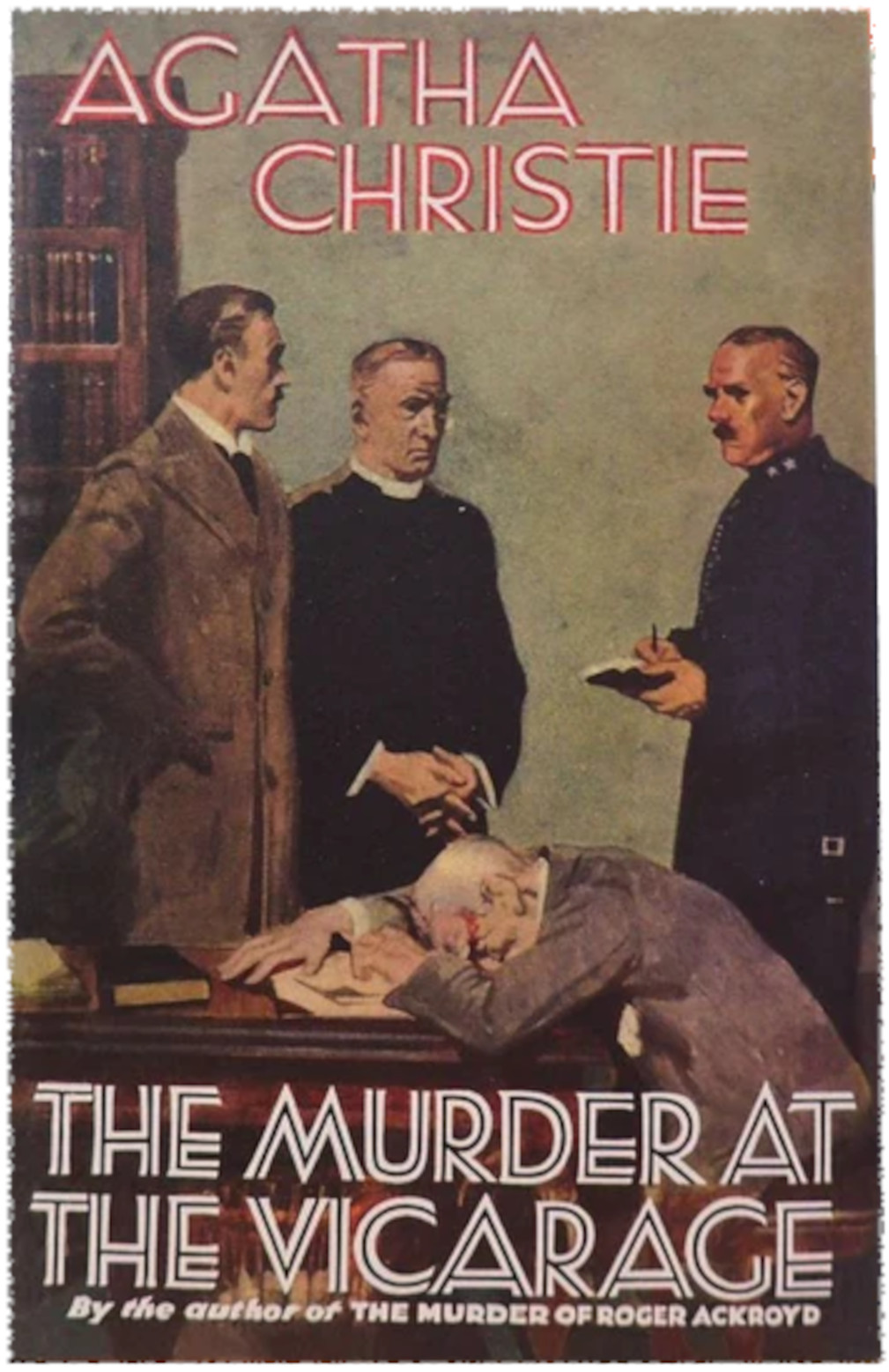
In 1930, The Murder At The Vicarage was released, the novel by Christie in which you can enjoy more Wodehousian atmospheres, with environments and characters evoking a complete world, which enchants more than the yellow plot itself. Christie’s work, from 1920 to 1975, was increasingly successful in parallel with that of Wodehouse, and sometimes these consonances can be felt both in the style, setting and especially in a conception of life, which Christie well represented in her autobiographical texts.
The personal relationship between the two authors is documented by correspondence in old age (recently published), where in exchanges of confidences between successful professionals, the mutual esteem and a similar ironic and cordial vision of life can be seen. In 1969, Christie dedicated to Wodehouse the book Halloween Party (unfortunately not the best, if not the worst):
To P.G. Wodehouse — whose books and stories have brightened my life for many years. Also, to show my pleasure in his having been kind enough to tell me he enjoyed my books.
On the other hand, Christie had well in mind the Wodehousian characters, until she planted them among the archaeological excavations in Iraq, very well known to her since she was accompanied by her Assyriologist husband Max Mallowan; in the exciting Murder in Mesopotamia (1936) the nurse who narrates in first person observe that
Mr Coleman’s manners were more like those of a Wodehouse hero than those of an ordinary young man.
Vertigo 1.
Wodehouse and Agatha Christie meet as a couple in Ludwig Wittgenstein’s favourite leisure readings. Several fans of the two writers, in addition to being pleased with it, have tried to analyze this predilection, investigating the linguistic and logical structure of their texts, which frees them from the same genre literature, and offers in many cases a sophisticated intellectual pleasure.
The original source is an episode of 1936 reported in Conversations with Wittgenstein2 by M.O’C Drury:
At lunch the talk revolved around detective stories: Wittgenstein said how much he liked Agatha Christie’s stories. Not only were the plots ingenious, but the characters were so well drawn that they looked real. He thought that being able to write books of this kind was a typical English talent. Someone in the group advised him to read the stories of Father Brown of Chesterton. He made a grimace: — No, I can’t stand the idea of a Catholic priest playing detective. I don’t like it. ¶ Later, during our walk, we discussed humorous books. I was a little impressed to find that he appreciated the writings of P.G. Wodehouse. He said that he found the short story “Honeysuckle Cottage” one of the funniest things he had ever read. We continued to discuss how the taste for humour changed over the years.

Even Tolkien did not appreciate the stories of Father Brown of Chesterton (while he admired Agatha Christie). As for the reference to “Honeysuckle Cottage”3 authorizes some more reverie, imagining the vertiginous intelligence of the German philosopher to decompose and analyze the perfect device of the story, that stages an hyperbolic case of subversion of linguistic and conceptual codes by an unknown external factor. More simply, the hilarious effect of the story comes from the extraordinary and at the same time natural balance between the daily and the surreal, with which also here are parodied stories and languages of romance, thriller and noir novels.
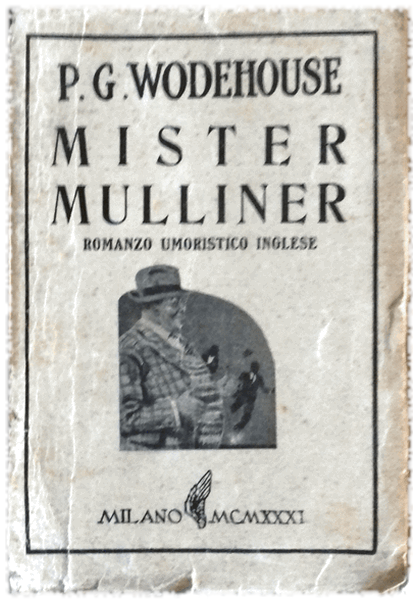
Imagining Ludwig Wittgenstein reading the series of stories by Mr. Mulliner4 is comforting from other points of view, as they combine the maximum simplicity and spontaneity of “being in common” in the Anglers’ Rest, where Mr. Mulliner tells the most disparate cases happened to his innumerable relatives, with an abstract humor in its stylistic measure.
Vertigo 2.
Readings faithful to the “Wodehouse code” are often surprising and intellectually challenging. It is of course Jeeves to guide, since its presentation, which takes place in “Jeeves Takes Charge” in Carry On, Jeeves (1925) (It. Trans. Avanti, Jeeves, Monanni 1928, with the unsurpassed translation by Silvio Spaventa Filippi):
I shall always remember the morning he came. It so happened that the night before I had been present at a rather cheery little supper, and I was feeling pretty rocky. On top of this I was trying to read a book Florence Craye had given me. She had been one of the house-party at Easeby, and two or three days before I left we had got engaged. I was due back at the end of the week, and I knew she would expect me to have finished the book by then. You see, she was particularly keen on boosting me up a bit nearer her own plane of intellect. She was a girl with a wonderful profile, but steeped to the gills in serious purpose. I can’t give you a better idea of the way things stood than by telling you that the book she’d given me to read was called Types of Ethical Theory, and that when I opened it at random I struck a page beginning: “The postulate or common understanding involved in speech is certainly co-extensive, in the obligation it carries, with the social organism of which language is the instrument, and the ends of which it is an effort to subserve”.
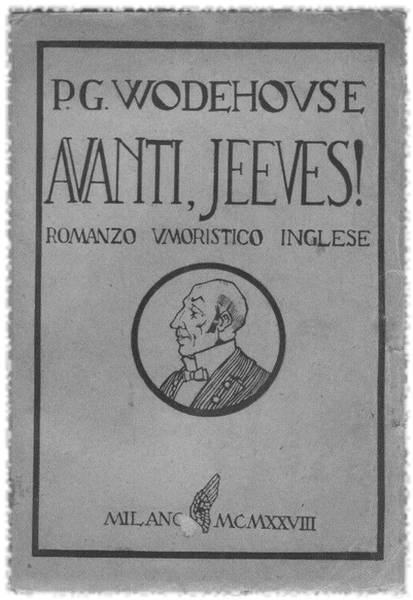
In front of the upset Bertie appears, sent by the agency, Jeeves, who puts him back together with a tonic of his invention, and is immediately hired. Later, working behind the scenes, Jeeves induces the rupture of the engagement between the master and Fiorenza Craye. Bertie does not like it...
— You’re sacked! —
— Very good, sir. — He coughed gently. — As I am no longer in your employment, sir, I can speak freely without appearing to take a liberty. In my opinion you and Lady Florence were quite unsuitably matched. Her ladyship is of a highly determined and arbitrary temperament, quite opposed to your own. I was in Lord Worplesdon’s service for nearly a year, during which time I had ample opportunities of studying her ladyship. The opinion of theservants’ hall was far from favourable to her. Her ladyship’s temper caused a good deal of adverse comment among us. It was at times quite impossible. You would not have been happy, sir! […] I think you would also have found her educational methods a littletrying, sir. I have glanced at the book her ladyship gave you — it hasbeen lying on your table since our arrival — and it is, in my opinion, quite unsuitable. You would not have enjoyed it. And I have it from herladyship’s own maid, who happened to overhear a conversation between her ladyship and one of the gentlemen staying here [...] that it washer intention to start you almost immediately upon Nietzsche. You would not enjoy Nietzsche, sir. He is fundamentally unsound. —
The next morning, after reading another passage of the book:5
— Jeeves,’ I said, when he came in with my morning tea, ’I’ve been thinking it over. You’re engaged again.-
— Thank you, sir.-
Liquidated here Nietzsche — and elsewhere Marx— Jeeves professes his cult for Spinoza. In Joy in the Morning (1947) Bertie wants to make a gift to his precious valet:
— Well, sir, there has recently been published a new and authoritatively annotated edition of the works of the philosopher Spinoza. Since you are so generous, I would appreciate that very much. —
— You shall have it. It shall be delivered at your door in a plain van without delay. You’re sure you’ve got the name right? Spinoza? —
There are hilarious scenes in the bookstore, where they have never heard that name:
— You do not mean The Spinning Whee? —
— No —
— It would not be The Poisoned Pin?—
— It would not. —
— Or With Gun and Camera in Little Known Borneo?
— he queried, trying a long shot.
— Spinoza. — I repeated firnaly. That was my story, and I intended to stick to it.
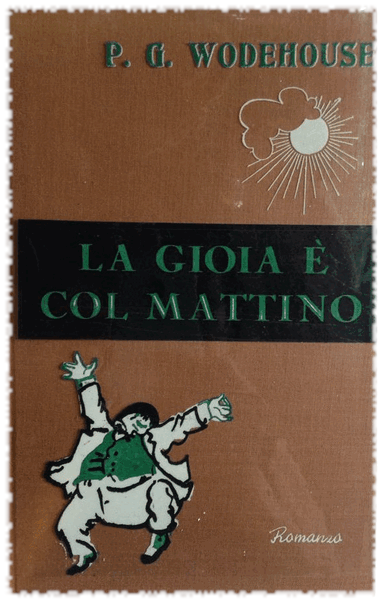
This scene is fatal because by chance in the library there is also Fiorenza Craye, who gets a wrong idea about Bertie’s cultural interests, so his unfortunate engagement foolows. Wodehouse’s specialists have wondered if it is because of this episode that Spinoza was chosen, or if some kind of connection can be intuited between his philosophy and the personality of Jeeves. This is a not a weird theme, because, regardless of whether it is intentional or not by the author, the psychological and behavioral elements of Jeeves as described in the novels constitute a human complex that would correspond to that described in Ethics.6
The fact that Wodehouse cared about this motive, beyond the mockery the very ignorant Bertie, is demonstrated by its reprise in Jeeves in the Offing (1960, It. trans. Jeeves taglia la corda):
— Sorry to keep you waiting, Jeeves,— I said. — Hope you weren’t bored?—
— Oh no, sir, thank you. I was quite happy with my Spinoza. —
— Eh? —
— The copy of Spinoza’s Ethics which you kindly gave me some time ago. —
— Oh, ah, yes, I remember. Good stuff?—
— Extremely, sir. —
— I suppose it turns out in the end that the butler did it. —
Ring for Jeeves.
A particular and rich accumulation of quotations is found in Ring for Jeeves (1953, It. Trans. Chiamate Jeeves, ed. Elmo with magnificent translation by Adriana Motti). Perhaps because Jeeves is on loan and away to Bill Belfry, Lord Rowcester, if possible even more ignorant than Bertie?
In addition to Latin locutions and French sayings, the text ranges, mostly through the mouth of Jeeves, from the classics Marcus Aurelius and Pliny the Young, to Shakespeare several times, Congreve, Keats, Shelley, Flaubert, Walter Scott, Tennyson, Kipling, Hemingway, Maugham, but also to Zoroaster and Omar Khayyam, then Sherlock Holmes, Agatha Christie, the artists Rodin and Whistler and the stars of the musical Hammerstein and Cole Porter.

A reduced format Jeeves appears, in thriller sauce, in the stories of “Black Widows” started in 1972 by Isaac Asimov, great admirer also of Agatha Christie, published in magazines and five collections until 1991. In them six gentlemen meet in a Circle for fine dining and to tackle enigmatic crimes. But each time the case is solved, with a nonchalant insight, by the butler Henry Jackson. Asimov claimed to have been inspired by Jeeves, in combining investigative acumen with imperturbability and discretion.
From Lady of Shalott to Lady Godiva.
After the Bible and Shakespeare, the most cited texts are those of Sir Alfred Tennyson, a specimen author of the Victorian era. In relation to his poems, Wodehouse uses a particular tone, between the ironic and the nostalgic; while it is fierce with the stingy sentimentalism of Madeline Basset, lingers, even in the humorous context, on Tennyson’s poetry, and significantly emphasizes, also with quotations from poems, the perfect knowledge by Jeeves.
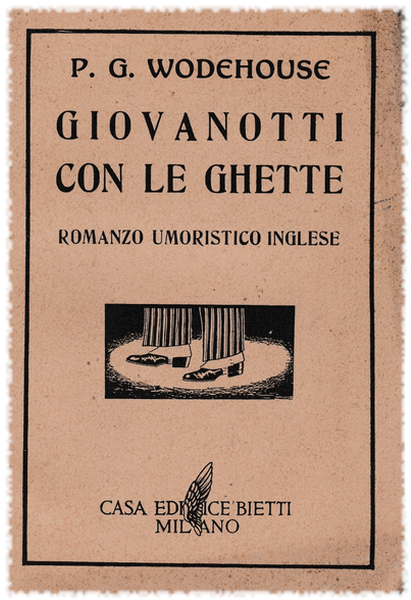
In 1936, when Agatha Christie imagined Bertie’s emulators in Mesopotamia, Plum released a collection of stories published in magazines, Young Men in Spats (It. Trans. Giovanotti con le ghette, Bietti 1937) and scattered his young men in spats form the Drones Club in urban or popular contexts, in country houses, in places of worldliness, behind sudden love and hilarious adventures; in the absence of Bertie and Jeeves, make their first appearance Freddie Widgeon, Pongo Twistleton, Archibald Mulliner, but especially uncle Fred, who we like to think of as one of the alter ego of his inventor. The jewel in the collection is the short story “Trouble Down at Tudsleigh”, in which Wodehouse succeeds in the extraordinary feat of ridiculing the cult of Tennyson and simultaneously giving the desire to read it and enjoy it.7 Freddie Widgeon falls in love with April, assiduous reader of the Victorian vate,8 and to woo her, having obtained the book of his poems, he memorizes “The Lady of Shalott” to show off in conversation with his beloved:
— Lancelot, you know. Tennyson, you know. You remember in the “Lady of Shalott” […] —
The girl stared at him, dropping a slice of bread-and-butter in her emotion. —You don’t mean to say you read Tennyson, Mr Widgeon? —
— Me? — said Freddie. — Tennyson? Read Tennyson? Me read Tennyson? Well, well, well! Bless my soul! Why, I know him by heart — [...].
—S o do I! “Break, break, break, on your cold grey stones, oh Sea… —9
—Quite. Or take the “Lady of Shalott”.— […]
—Dashed extraordinary that you should like Tennyson, too.—
—I think he’s wonderful.’ —
—What a lad! That “Lady of Shalott”! Some spin on the ball there.—
— It’s so absurd, the way people sneer at him nowadays. —
— The silly bounders. Don’t know what’s good for them. —
— He’s my favourite poet.—
— Mine, too. Any bird who could write the “Lady of Shalott” gets the cigar or coconut, according to choice, as far as I’m concerned.—
Things seem to go smoothly, but unfortunately the unwary Freddy says to the pestiferous little sister Prudence:
— Tennyson’s heroines, — said Freddie, — are jolly fine specimens of pure, sweet womanhood, so get that into your nut, you soulless kid. If you behaved like a Tennyson heroine, you would be doing well. —
So the terrible girl will emulate the Lady Godiva of another famous poem by Tennyson, and the romance will end badly.
“Godiva” has itself an ironic incipit that perhaps alludes to railway delays...:
I waited for the train at Coventry;
I hung with grooms and porters on the bridge,
To watch the three tall spires; and there I shaped
The city’s ancient legend into this.
Joy in the morning.
Wodehouse combines the shimmering abstraction of style and the evocation of a fairy-tale era with the empathy and concreteness of nature and human community. Wodehouse is neither Bertie, nor Jeeves, nor Mister Mulliner, but it is perhaps Psmith, the energetic fitter, and then, in maturity, Uncle Fred who everywhere wants to spread sweetness and light, or the unrepentant Galahad, o Lord Emsworth who looks at the world with equal sympathy.10
Here it is the effect of comfort:11 joy that strengthens, strength that rejoices.
It is a state of “serene knowing”, it is the “Kuinzige”, which “no one conquers if he does not already have it”, as Martin Heidegger argues:
Its meaning goes roughly in the direction of Socrates’ irony, which cannot be summarized. The word refers to a cheerful and melancholy superiority towards all that is ordinary and usual, and it is always taken too seriously — but this superiority has nothing of haughty, nor the kind of mischievous derision. The “Kuinzige” implies a native affection for people and things, and a genuine concern for them; but it does not consciously try to remain inscrutable, which could be easily misunderstood as deception.12
The elusiveness and irreducibility of Wodehouse’s work to the idiocy of the politically correct and of woke totalitarianism brings to mind other writers in which humor has the power of a superior and merciful look on human: to the great Achille Campanile, our italian comfort, and none other than Albert Cohen, as to the parodic description of the bureaucracy of the League of Nations and the worldly anxieties surrounding it:13
(Mrs Deume has hired a hotel maître d’hôtel for a gala dinner and gives him instructions)
— You may begin to prepare the table, according to the rules, of course. So, there will be five of us, including the Under-Secretary-General. The key to the dining room I gave it to the maid who will help you. The napkins, as usual, in a fan.
— Please, ma’am?
— The napkins, I was saying, folded in a fan, like we always do when we have guests.
— Fan-fold? Well, ma’am. I must point out to that this has not been used for a while. For lunch, napkin simply folded and put on the plate. For dinner, placed on the plate of bread, always simply folded and with the roll inside, to the left of the soup dish served first. In any case, it is thus that His Royal Highness the Duke of Nemours, where I had the honor of serving for ten years. But if the lady cares, I can fold her napkins to fantasy, fan, umbrella, wallet, bicycle wheel, swan, and even camel imitation. As the lady wishes. I am at her command.
— I do not give any importance to such details — said Mrs Deume, red brick in the face, — Do as you wish. They are trifles.
Wodehouse has included many quotations from the Bible in his works, and to a novel, which we have already mentioned, he gave the title taken from a Psalm, which goes beyond the story that is told: Joy in the morning (1947):14
For his anger lasts only a moment,
but his favor lasts a lifetime;
weeping may stay for the night,
but rejoicing comes in the morning.
(Psalm 30, 6)
Notes
* Two quotes in this issue, the one from Louder and Funnier (p. 1) and the one from Conversations with Wittgenstein (p. 4) are translated from Italian. If any kind reader would send us the original text, we would be grateful. il.covile@protonmail.com
1 Unfortunately, several collections of Wodehouse stories have never been translated and published in Italian. In the face of this, it is not understood why we return to always publish the same novels of the most known cycles, often with new, not even necessary, translations.
2 Drury, M. O'C., «Conversations with Wittgenstein», in R. Rhees (ed.), Recollections of Wittgenstein. Oxford University Press 1984; It. trans. Ludwig Wittgenstein, Conversazioni e memorie, Neri Pozza ed. 2005. Text translated from the Italian edition p.183.
3 «Honeysuckle Cottage» appeared in magazines in 1925 in the UK and USA, then in 1927 (with appropriate modifications) as ninth chapter added in Meet Mr. Mulliner (It. Trans. «La villa del Caprifoglio» in Mister Mulliner ed. Monanni 1931 then Bietti 1933).
4 Meet Mr. Mulliner (1927), Mr. Mulliner speaking (1929), Mulliner’s Nights (1933), as well as stories in other collections. Wittgenstein may have read the story outside of the series, in the magazine edition. The collections were published in Italian respectively as Mister Mulliner (Monanni 1931, then Bietti 1933), Parla Mister Mulliner (Monanni 1931, then Bietti 1933), Le serate di Mulliner (Bietti 1933), all with excellent translations by Alberto Tedeschi.
5 The book will remain a scarecrow for Bertie who will cite another piece in Joy in the morning (1947) when, making the list of his ex-girlfriends, he will mention Fiorenza Craye as one of the worst risks avoided.
6 V. https://sex-in-spats.livejournal.com/6628.html.
7 From the reading of this story was born the passion of the Covile for the «Lady of Shalott», see Il Covile №581 of April 2010.
8 Freddie breathes a sigh of relief when he sees that it is Tennyson, because «it could also have been Shelley or Browning».
9 It’s an 1835 poem by Tennyson, but Freddie only knows «The Lady of Shalott»: Break, break, break, / On thy cold gray stones, O Sea! / And I would that my tongue could utter / The thoughts that arise in me.
10 Critics have observed that, as the Blandings saga progresses, Galahad takes on more and more of the beneficial character of Lord Ickenham (Uncle Fred). This is confirmed in the novel with which cycle ends in 1975, together with Wodehouse’s life itself: the unfinished Sunset at Blandings, which will be published in 1977 (and never translated into Italian) with an allusive title chosen by the publisher.
11 V. Dean Abbot, «P.G. Wodehouse: Balm for the Modern Soul» https://theimaginativeconservative.org/2018/02/p-g-wodehouse-dean-abbott.html.
12 Il Covile №714, January 2025.
13 Albert Cohen, Belle du Seigneur, Gallimard 1968. The novel was first written from 1935 to 1938. In the merit of this episode, Cohen’s gaze is amused but ruthless. The relationship between poor lady Deume and the haughty waiter is not an empathic relationship — as it is always anyway among the characters of Wodehouse — but a fierce skirmish, between the parasitic bureaucracy socially rising and the servile class, faithful to the ancien régime. The outcome of the clash will then be even more terrible, since the high official of the League of Nations for whom the «elegant dinner» at Deume house was organized, will not show up.
14 We also remember the story in which Wodehouse was involved until after the war, and that led to his definitive transfer to the USA. In the Italian edition Elmo, was published in the foreword the text «In defence of P.G. Wodehouse» by George Orwell. V. Il Covile №414 May 2017 and №696 June 2024.
www.ilcovile.it
Wehrlos, doch in nichts vernichtet
Inerme, ma in niente annientato
(Der christliche Epimetheus
Konrad Weiß)