Stefano Borselli
MAMA’S BOY TRILOGY
Augustine, Leopardi, Montale, Kafka, Debord and Other Myths Between NoMn-Reception, Dereliction and the Duty of Glory
Sixth Edition October 23, 2026. Preliminary translation.
Index
Warning.
The aim of this text is not to explain the world, nor to propose a unified theory of the human problem, nor to identify iron laws of determinism; if anything, it points to recurrences, correlations, fields of force, contributory causes. If we were to single out one objective, we might say that it aims to outline a familiar pattern—a dynamic involving psychological and productive archetypes that are by no means rare. Anyone moving in urban environments of middle and high culture can spot it in their own surroundings without difficulty. If, based on what is presented here, someone were to reconsider the judgments and assessments they make about others and themselves, that would already be an achievement. ¶ A clarification is obligatory: to highlight the sometimes extremely weak, when not openly ridiculous, aspects of the behavioural and rhetorical pattern of the “mama's boy” (or “bamboccione”, if one prefers) is deemed necessary for clearing the ground and for a vital liberation — as often happens with the public and ostentatious violation of a taboo. This must not, however, induce reproach, but rather compassion and empathy. Flaubert docet: “Madame Bovary c'est moi”: we are all mama's boys. And if one takes important things seriously, this follows a fortiori from Terence's principle: “Nihil humanum a me alienum puto”. No individual articulates a single pattern. We all participate, in different measure, in every behavioural and symbolic structure. It is always a question of scale, of relative intensity and of overall equilibrium that makes each individual unique. ¶ One should, however, bear in mind Jünger, A Dangerous Encounter (Adelphi, Milan, 1986, p. 117):
“But isn't it said that whoever understands everything forgives everything?”¶ “So it is said. But it is another of those proverbs that make no sense, one of the most beloved commonplaces there are. Whoever understands everything does not understand only the guilty man, but also the judge who pronounces sentence against him and the executioner who carries it out. I would say more modestly that even if I do not understand the facts and their connections, I admire them as a masterpiece”.¶ “Then you think differently from those who say that God cannot exist because this world is a place of horrors”.¶ Dobrowsky laughed. “Even if I am but a wretched policeman, you won't attribute such banalities to me”.
To understand the amputations that shaped a murderer does not mean to forgive him, nor to weaken the community’s response — rage, repulsion, defence. Not an irenic pardon, then: rather, as commissioner Dobrowsky says, to renounce the pretence of understanding to the bottom, and to look at the configuration — amputations, compensation, outcome — as one looks at a completed mechanism. ¶ One must not forget, moreover, that the pattern highlighted here is but the pathological development of a natural variation within the species. As lateralization in right-handed, left-handed or ambidextrous individuals is collectively more efficient than pure, homogeneous symmetry, so anxious and heedless, hylic and pneumatic, prudent and reckless, the slow and profound and the fast and brilliant represent original, healthy polarities, necessary to the survival of the group. ¶ Various references to the Minimal Theory of the Abstraction Process (mtap) show how much it is both premise and foundation of this text, which can even be read as its gloss. The reader can find in the appendices an explicit presentation of that theoretical work, notably the note on Tiqqun in the second and the entire third, “The Dates of Capital”. Coherently with a perspective that invites a direct, unshielded confrontation with reality, the reader is therefore referred and invited to turn directly to the sources: to the original text of the Gemeinwesen Group, where the anthropological posture outlined here is placed in a far broader inquiry into that “redemptive motor” and activistic drive that feeds the millennial “process of abstraction” that mtap treats.
The following table is not the result of a classification project. It is the outcome of a long reflection—discussed in greater detail in the conclusion—that gained momentum from a striking insight by Jacques Camatte regarding the maternal matrix of Augustine’s work. This hypothesis, initially tested on Augustine, was gradually extended to other authors, and it was surprising to find that, despite profound biographical and cultural differences, certain commonalities also emerge in the family histories of Leopardi, Kafka, Montale, and others. The table, which compiles my assessments, illustrates these commonalities; their interpretation is the subject of the pages that follow. ¶ A clarification. These judgments—and hypotheses are judgments as well, albeit less binding—are based on known facts, evidence, and clues, but they never derive directly from them; otherwise, they would not be judgments. This holds true in courts—including the court of history—as well as in the circumstances of life, both personal and collective. Evidence guides judgment but does not determine it: the final step is always an independent leap. In this case, the judgments are my own—a fact that will not be repeated with every attribution. For this reason, the evaluation of each choice in the table is left to the readers, whether they are sympathetic or not.
For a phenomenology of the illustrious mama's boy.
| Childhood Pre-adolescence |
Adulthood | ||||||
| 1 Maternal Mandate |
2 Absence of affective caresses |
3 Tribe not experienced |
4 D&N |
5 Amputations |
6 Compensation |
7 Radical pessimism |
|
| ◎Augustine of Hippo (354) | CE | Yes | ? | DN | Yes | Yes | Yes |
| Lotario di Segni (1160) | PE | ? | ? | DN | Yes | Yes | Yes |
| ◎Alessandro Manzoni (1785) | CE | Yes | Yes | D | Yes * | Yes | Yes |
| Arthur Schopenhauer (1788) | PE | ? | Yes | N | Yes | Yes | Yes |
| ◎Giacomo Leopardi (1798) | CE | Yes | Yes | D | Yes | Yes | Yes |
| ◎Philipp Mainländer (1841) | CE | Yes | ? | D | Yes | Yes | Yes |
| ◎Friedrich Nietzsche (1844) | R | Yes | Yes | D | Yes | Yes | Yes |
| ◎Léon Bloy (1846) | CE | Yes | Yes | D | Yes | Yes | Yes |
| ◎August Strindberg (1849) | R | Yes | Yes | D | Yes | Yes | Yes |
| Robert Musil (1880) | PE | ? | Yes | DN | Yes | Yes | Yes |
| ◎Franz Kafka (1883) | CE | ? | Yes | D | Yes | Yes | Yes |
| ◎Carlo Michelstaedter (1887) | CE | ? | Yes | D | Yes | Yes | Yes |
| Walter Benjamin (1892) | PE | ? | Yes | D | Yes | Yes | Yes |
| ◎Eugenio Montale (1896) | PE | ? | Yes | DN | Yes * | Yes | Yes * |
| ◎Roberto «Bobi» Bazlen (1902) | CE | Yes | Yes | DN | Yes | Yes | Yes |
| ◎Jean-Paul Sartre (1905) | PE | Yes | Yes | N | Yes | Yes | Yes |
| ◎Michel Foucault (1926) | CE | ? | ? | D | Yes | Yes | Yes |
| ◎Thomas Bernhard (1931) | CE | ? | Yes | DN | Yes | Yes | Yes |
| Guy Debord (1931) | PE | Yes | Yes | N | Yes | Yes | Yes |
Legend.
• Maternal Mandate — The very presence of an author in the table is contingent upon two assumptions regarding the mother—her emotional detachment and the mandate she assigns to her child: either to demonstrate an exceptional quality that confirms her own, or to pass on the one she herself feels she has received—and one regarding the author: his radical pessimism. ¶ In literature, that of the wife who feels herself in some way superior to her husband is a recurring figure, from Emma Bovary who despises the mediocrity of her spouse to Anna Karenina who laments his aridity. ¶ In our case, we are dealing with a particular, distinct form of conflict: the mother’s sense of being an exception—of superiority as refinement and nobility of spirit (in other words, the “pneumatic” being as opposed to the coarseness of the “hylic” being), often perceived not as a personal trait but as one of lineage (living lineage: her father, mother, grandfather, and grandmother)—even an imaginary one: such as the “children” of alleged liaisons between an illustrious ancestor and maidservants, or not of rank but of condition: the woman as a crystallized nymph, who does not allow herself to be melted by the encounter with the masculine, Pan-like side and does not become a living mother.1 ¶ The above pertains to the more frequent cases in which this exceptional nature is, as it were, brought into the marriage as a dowry; in other cases, it appears to be triggered by a reaction—a form of retaliation against the social and factual superiority of the husband and his family (in-laws, brothers-in-law, etc.)—which, from a certain point onward, is viewed as false, disappointing, and fleeting in comparison to one’s own sensibilities, which are discovered to be, in fact, more elevated and therefore more refined. ¶ There thus emerges a “we” (whose individual pneumaticity is often entirely belied by the facts, and merely imaginary). A “we” defined by the active or de facto exclusion of the spouse from the crucial role assigned to the child: exceptionalism is binary, and “they” are, by definition, all those who are not exceptional compared to “us”. However, exceptionalism is recognized more by the behaviors and the maternal image that the child presents to us than by the mother’s statements about what she believes she thinks: “Sie wissen das nicht, aber sie tun es” (They do not know it, but they do it; Marx, Capital, Vol. I, Book I, Chapter I, §4). Furthermore, in many cases—seemingly asymptomatic—the power struggle is silent—as the adages “gutta cavat lapidem” and “still waters run deep” rightly suggest—but it escapes only a superficial and hasty reading. When we have the exclusive, spousal-only, access to the circles and salons of the elite; when the father, whether by choice or due to the mother’s dominance, counts for nothing in decisions regarding his son; when the mother takes over from the father in shaping the son's moral character and personality; when the son speaks of his mother as implicitly superior—in intelligence, consistency, or otherwise—and the father, in his eyes, does not measure up; when he does not remember his father: exceptionalism is present. See further on the relevant chapter: “Wife's exceptionalism (usually illusory)”. An important correlation must be added: real or claimed, pneumatic election — in itself a yearning for disincarnation — is more often accompanied by anaffectivity. ¶ There are three values assigned in the corresponding column: CE, PE, R. CE → a sense of exceptionalism that is confirmed and detectable in the data; PE → a probable sense of exceptionalism inferred from data showing status, rank, social circle, or other factors; R → a desire for revenge against the husband or his family in response to their claimed superiority.
• Absence of affective caresses — In the proper, corporeal-animal sense, à la Ashley Montagu. Anaffective mother, emotionally inaccessible, physically absent or dead. But the corporeal dimension alone does not exhaust the notion: in psychology one distinguishes between real affective caresses and instrumental and anxiogenic ones. For Winnicott this produces a lack of solidity in the core of the self. Let us add that in nature, not only for humans, the system of reception after birth is robust, redundant and capable of supplying the absent mother, for example one dead in childbirth. When it fails, it is not one mother alone who fails, it is a network. It is known that the system includes substitutive allomothers: grandmothers, aunts, wet nurses themselves, sisters, even males if capable: father, brother, grandfather, etc. Yet sometimes the network is not there or is blocked for various reasons. ¶ We note that many paths leading to anaffectivity converge in this column: lineage, the crystallized nymph, the absence or death of the mother, and instrumental affection; distinguishing them into separate columns is a task we leave to others.
• Tribe not experienced — Not simple introversion but factual non-participation (or participation below threshold for scarcity and extraneousness) in the virile games of children, “the tribes of children with slings” of Montale, where one learns both to measure oneself against external and multidimensional criteria and to relate to others, real ones. Articulated and varied motives, for heterogeneous and often opaque reasons: family and social-class pressure, its interiorization, psyche, etc. The tribe, if it tries to integrate him, eventually resigns itself.
• D&N Dereliction and narcissism — Associated with primary non-reception is a co-presence, visible already from adolescence, of dereliction (failed formation of the self, difficulties, objective and lived, in finding a place in the world — in affections, in the family, in career, in the community) and narcissism (anxiety to have an audience in which to appear — to oneself and, at least in some measure, objectively — superior). The values attributed: D (=prevalent dereliction), N (=prevalent narcissism), DN (=equilibrium between the two).
• Amputations — The Elusiveness of the Simple, Everyday, Carnal, and Its Joy: the unforgettable moments of love, a hard-fought victory on the soccer field with your team, a beer with friends, the night spent with everyone on the banks of the Po as it threatens to overflow, your five-year-old daughter’s smile and antics.
• Compensation — Imaginary redemption through a sense of intellectual/moral/aesthetic superiority, in a world that is an insolvent debtor; frequent lamentatio, with its everlasting themes. Derision (irony, spleen, contemptuous detachment) towards “gross” vitality and ordinary masculinity, normal life: “Living? Let our domestics do it for us” (Villiers De L'Isle-Adam cited by Montale). ¶ But things have consequences. A type so formed will relate to the other with the sole, unconscious aim of extracting his compensatory enjoyment, an ersatz that, in order to subsist, requires feeling himself the end, facing an interlocutor degraded to inferior and coarse. One will not be surprised, then, to observe, by dynamic reaction, the live and equally contemptuous response of some candidate for inferiority who is less thoroughly normalized.
• Radical pessimism — The belief that being or contingency is fundamentally marked by suffering, lack, absurdity, corruption, and evil. Sometimes this belief is explicitly stated (as in dualistic Gnosticism or Augustinianism), and sometimes it is implicit (as in Foucault, who describes it only as a practical stance—“pessimistic activism”—because his theoretical system has deprived itself of the means to name evil).
This table is intended to represent the current state of an ongoing research project. Attributions: Yes (= high to very high probability based on evidence or testimonies), ? (= probable, but inferred—for example, emotional detachment resulting from neglect—or hypothesized). The symbol ◎ before a name indicates cases where the combination of biography, letters, testimonies, and analysis of the work is, in my judgment, convincing; in the other cases, the data are insufficient or the investigation is not thorough enough, and further research is needed. The last three columns (amputations, compensation, radical pessimism) are attributed directly from the written work. The assessments are rough estimates, based on clues and probabilities, as in medicine or in a courtroom, using the standard of “more likely than not” rather than “beyond a reasonable doubt”; others may assign different weights. The asterisks next to two “Yes” entries for Montale indicate a shift in perspective from the early 1970s, described later; the asterisk next to the “Yes” entry for amputations regarding Manzoni is also discussed later.
Notes on “mama's boy”.
“Mama's boy” is the brusque verdict issued by the tribe: at once sanction and justification of the factual self-exclusion (or exo-exclusion, or endo-exclusion). “Don't even bother asking if he's coming with us to play hooky from school — you know he's a mama's boy”. It also exists in Italian as cocco di mamma, in French as fils à maman (thus Sartre describes himself between the lines, speaking of his companions, in Les Mots), in German as Muttersöhnchen, and in English as mama's boy in American usage, mummy's boy in British. ¶ Operative use of the term: in its simple and “pure” form, this is the mechanism: the mother terrorizes the son telling him to stay away from the wild children (the tribe), bad and, moreover, poor. See Montale. The child is thus formed. The tribe, however, is a complex and articulated social body made of hard and understanding, extroverted and introverted, “good” and “bad”, capable of managing diversities. Often it tries to integrate the boy, but in the end it resigns itself. When a well-meaning friend insists, the others tell him: “Leave it, we've already tried...”. That resignation of the tribe — which nevertheless knows how to welcome and manage differences — confirms that the child had already been “formed” elsewhere, indoors. This is the ordinary case (both of the excluded and of the tribe), with variability, even pathological, in both directions. The mama's boys, all scholars, tell their story.
Maternal Mandate. The Cases.
Augustine of Hippo. Monica belonged to the Christian elite of Tagaste — fiercely Catholic in a milieu of pagan notables and Donatist Christians. Her father Patricius was a pagan, and remained so until the last years of his life. The conflict was not merely one of temperament but of identity: Monica carried the certainty of the elect, Patricius the ordinariness of the world. In the Confessions Augustine recounts at length his mother's directional weeping — the Bishop of Tagaste, who had tasted them, will say to her: "It is impossible that a son of so many tears should be lost" — but not her maternal caresses and embraces. Monica appears as a woman of strong character, who would not let go until she had won, tireless — like Donna Prassede, the domineering, pious busybody of Manzoni’s The Betrothed — in "seconding the will of Heaven," bending others to it — her husband, her son, her "daughter-in-law." Regarding the latter, Agostino’s erasure of the name of his son’s mother and of the person who sought his expulsion—he writes, “she was torn from my side,” a passive construction without an agent, as if it had rained—even though two chapters earlier he recalls that his mother was working toward an advantageous marriage, in which the woman was the obstacle. This silence may be a sign of filial deference, but elsewhere Agostino is frank with his mother (regarding her ambitions for his career, the attachment in which he sees the relics of Eve): we interpret this as the repression of a submission that, in that instance, was too painful—a sign of the mother’s hold over an infantile self that delegates its own choices to her.
Lothair of Segni. Biographical information is scarce. His mother, Claricia Scotti, belonged to the senatorial lineage of the Romani de Scotta, a clan of Rome’s high curial aristocracy traditionally linked to Pope Clement III. His father, Trasimondo, Count of Segni, was a member of the military nobility of the province of Lazio. His maternal lineage possessed curial and Roman wealth that proved decisive in Lothair’s early rise within the Church. His early work, De miseria humanae conditionis, composed between 1194 and 1195, is the most powerful text of radical pessimism in the Middle Ages. Upon ascending to the papal throne as Innocent III, he brought the assertion of papal primacy to its zenith.
Alessandro Manzoni. Giulia, the daughter of Cesare Beccaria, brought to her marriage with Pietro Manzoni—who was much older than she—the prestige of an illustrious lineage and the cultural refinement of Milan’s Enlightenment circles. Alessandro was sent to boarding school at the age of six (1791; first to the Somaschi, then to the Barnabiti until he was sixteen), in an environment characterized by a strictness whose nature I will describe in more detail later, in the entry on Leopardi. In 1792, Giulia separated from her husband and lived with Imbonati in London and Paris; her son did not join her until 1805, at the age of twenty. The following year, Manzoni composed the poem In morte di Carlo Imbonati (On the Death of Carlo Imbonati), in which his mother’s companion, who had recently died, dictates to the poet—in a manner almost like a last will and testament—his own principles of life. ¶ In The Betrothed, simple, uncalculated, unthreatened joy—joy for its own sake—is almost entirely absent, but there is at least one significant exception: the merchant’s wife in chapters XXXVI–XXXVIII: a widow and mother who had lost her children, she became Lucia’s protector, with whom she is “both tender and playful,” and whom she teases “gently, without pushing too hard—just enough to compel her to show all the joy she had in her heart.” It was Aldo Spranzi who pointed out the anomaly of this character, within the framework of a more general thesis of religious pretense: he saw in her an amoral and naturalistic mindset that can be traced back to Manzoni himself, albeit in a veiled form (see, e.g., his Il segreto di Alessandro Manzoni, Unicopli 2001, pp. 280–283). We are convinced—supported, moreover, by what is now a wealth of biographical research on the Manzoni family and the Milanese Enlightenment elite, beginning with Natalia Ginzburg’s *La famiglia Manzoni*—that the novel can indeed be read as a truly dark text; but we are not necessarily convinced regarding the notion of pretense. Rather than a fallen mask, one can read in it the natural reemergence of simplicity and the joy of being in the present after tragedies. In those pages, Manzoni certainly highlights a perspective—perhaps unique in the novel—in which the joy of life is a free, undeserved gift that requires no moral or religious justification. Nor do we follow him in reading into it a Luciferian indifference or a transgression of mourning: even Niobe, as Achilles reminds Priam, ate.
Arthur Schopenhauer. The mother Johanna was an established writer, a frequenter of the Weimar salon, a friend of Goethe. The father Heinrich Floris was a capable merchant but afflicted by depression, who probably died by suicide.
Giacomo Leopardi. Adelaide Antici brought into her marriage the weight of a marquis’s lineage and a logical, rigorist religious upbringing, likely steeped in the crypto-Jansenism that permeated Italian Catholicism between the 18th and 19th centuries: condemned and therefore kept underground, shielded by the Dominicans—who were always allies of the Jansenists against the Jesuits—until it emerged briefly with Scipione de’ Ricci. The father Monaldo was a decayed count, an inconclusive bibliomaniac, economically dependent on his wife. Adelaide's exceptionalism is documented by Giacomo himself. Keep in mind that, within the logic of class identity, a marquis must be more vigilant about his distinction from a mere count than about his distinction—which is unproblematic—from a peasant. “Mésalliance”—marriage between unequal noble ranks—was frowned upon in European noble culture. We do not know why it was stigmatized: was it because it violated the separation of ranks, because of too many quarrels between the spouses, because of both, or for some other reason?
Philipp Mainländer. A true icon of pessimism, he leads Leopardi’s philosophy to a redemptive conclusion that proposes the self-extinction of the species. In his autobiographical account, he identifies his parents’ anaffective sexuality as one of the starting points for his reflection. His mother, whom he describes as resistant to marriage and her own sexuality—perhaps as a result of the experiences of the philosopher’s grandmother—perceives herself as a nymph violated by a brutal husband (in Hillmanian terms): an exceptionalism not of rank but of condition, transmitted through the female line. Mainländer attributes his early rejection of marriage—“Wir sind keine Kinder der Liebe, sondern Kinder ehelicher Notzucht” (we are not children of love, but children of marital rape)—and his exaltation of virginity to that parental situation.
Friedrich Nietzsche. Franziska Oehler, the daughter of a pastor and the widow of a pastor, finds herself in a house—that of her mother-in-law—where she is the daughter-in-law of humblest origins and where she counts for nothing. But she manages to raise the little boy in such a way that her in-laws’ attempt to send him to the public school, so he can cut his teeth, fails: Friedrich, already Mom’s darling, well-shod and well-dressed—called “little pastor” by his classmates for his otherworldly manner—will not fit in there, and his mother will secure his transfer to a private school, among others like him (Chesterton would see this clearly; he would recount in Orthodoxy*how afraid a cow was: if not true, it is well put). ¶ Her hold on her son does not stem from a choice: she seizes power. Her mission is one of revenge: they treated me as inferior, and you—Friedrich—must prove that I am not. The son inherits the war, not superiority. And he fights it his entire life: against his mother, against his sister, against the “herd,” against Christianity, against morality. His compensation—his work, his invective, his demolition—is the revenge his mother was unable to exact. But his revenge fails: Nietzsche becomes someone, yet he cannot free himself from his mother’s grip. The hatred for his mother and sister, in Ecce Homo, is proof of this: the bond remained.
Léon Bloy. His mother, Anne-Marie Carreau, brought to her marriage a sense of having been chosen, rooted in a proud Spanish lineage and interwoven with a sombre, absolute Catholic devotion. His father, Jean-Baptiste Bloy, was an employee of the Ponts et Chaussées administration—a layman, a Voltairean, and a rationalist. In Bloy’s autobiographical account—transfigured into the character of Caïn Marchenoire in Le Désespéré—the divide is clear: his mother embodies the spiritual nobility of suffering and faith, in contrast to his father’s coarse, carnal nature. In recounting his own conversion, Léon took the couple Monica and Augustine as his model. From his mother’s side—whom he describes as “a Christian of days gone by, a heroine”—Bloy could not draw upon the untried sweetness of physical embrace, but rather was endowed with a prophetic intransigence that would render him incapable of living an ordinary life.
August Strindberg. Ulrika Eleonora Norling, a former maid, marries the bourgeois Carl Oskar Strindberg, who elevates her social status but does not recognize her as an equal. She responds with pietism: a faith that reverses the hierarchy—socially the lowest, yet chosen by God. Her husband is the master; she is the martyr. And their son inherits this conflict: his mother instills in him the certainty that he is worth more than those in power, and the duty to prove it. August proves it: through invective, through theater, through misogyny, through the demolition of marriage and the family. But like Nietzsche, he does not free himself. His work is an escape that leads nowhere. And so the chart must read: R, with the outcome of perpetual war: the mandate is fought over, but it is never won or lost.
Robert Musil. The mother Hermine Bergauer imposes the fixed presence of the lover Heinrich Reiter in the house for decades, managing the ménage à trois with her nervous irritability, an energy that crushed the remissive husband Alfred, an esteemed engineer but temperamentally accommodating, incapable of countering his wife's personality.
Franz Kafka. See further on in the relevant chapter.
Carlo Michelstaedter. The maternal family Luzzatto-Coen belonged to the high Jewish bourgeoisie of Gorizia — cultured, well-off, aware of its own distinction. Carlo is born within this awareness and makes it philosophy: Persuasion is the maternal mandate brought to speculative completion. In the last letter, written little more than a month before his suicide, he writes to his mother that he is fulfilling the task he knows she expects of him: “now you will have the fruits of your long suffering, of your long hoping”.
H.P. Lovecraft. The figure of Susie Lovecraft embodies a blend of bourgeois haughtiness and hysterical instability. After her husband Winfield’s mental breakdown and death in an asylum (he died when Howard was seven years old), Susie exercised a suffocating control over her son, oscillating between stifling overprotection and the pathological conviction that Howard was unfit for the outside world: on the one hand, she regarded him as a chosen being; on the other, she treated him with a mixture of revulsion and terror toward normality: she had gone so far as to call him “grotesque” and disfigured, warning him not to show himself in public in broad daylight. Howard, too, grew up in a matriarchal household of mothers and aunts, with the exception of his grandfather, who served as a counterbalance. A sheltered childhood in the grand Providence mansion, the total absence of ordinary male social interaction, domestic confinement, and a perception of reality radically filtered through books, the ghosts of the library, and a terror of physical contact. His mother instilled in him the idea that the Phillips family, of the “old New England stock,” was of a caliber infinitely superior to the Providence average, isolating him in an aristocratic bubble of decadence and obsessions with decorum, until their financial collapse and his mother’s subsequent mental breakdown (she, too, ended up institutionalized).
Walter Benjamin. The mother Pauline Schönflies belonged to a family of the Jewish cultural aristocracy of Berlin — the uncle Arthur Schönflies was a mathematician of note. The father Emil was a businessman. The contrast between the cultural density of the maternal line and the commercial normality of the paternal one is a constant background in Benjamin's formation.
Eugenio Montale. The mother Giuseppina Ricci carried a double inheritance: the solid cultured bourgeoisie of the Ricci notaries and, through the maternal grandmother Alice Anna Schlesinger, a Viennese Jewish family of cultural tradition. The father Domenico was a well-off Ligurian merchant, concrete and business-oriented, who would have preferred to steer his sons towards the family firm. It was the mother who supported the artistic inclinations of the young Eugenio, against the paternal practical vocation.
Roberto “Bobi” Bazlen. His “terrible” mother, Clotilde Levi Minzi — “bound by a triple thread to a son in flight,” in Montale’s recollection — belonged to the world of collecting and to Trieste’s educated Jewish bourgeoisie, a family with a long-standing and self-conscious tradition of Central European intellectual distinction. His father Eugenio, a Lutheran merchant of German origin, died young, leaving the field to a maternal gynaeceum — his mother and aunts — which guarded its superior cultural election as a caste privilege, inaccessible to the outside world. In his personal memoir (Bobi, Adelphi, 2021), Roberto Calasso would write that, for Bazlen, “Trieste was already a malign cage, and at times ‘an infamous life,’ where decisive encounters [...] mingled with a family composed entirely of women (Bazlen’s father had died when he was three) [p. 33].” ¶ From his maternal lineage, little Bobi received not the bodily affection and welcome of the Simple, but the usual mandate, as Bazlen writes in his brief, vaguely Futurist attempt, Lotta con la macchina da scrivere (1925; see Bobi, cited above, p. 33):
I have tried over these last few days but the failure has been total I am sorry not for myself who will certainly be able to overcome this too but for my family who might well have expected something more of me [...]
The investiture thus takes the form of an oracular refinement that will leave him unable to inhabit ordinary life, to marry, to bring a work of his own to completion, or even to visit the terrible woman in person. Instead, he sent “friends” — pawns, or rather trophies dispatched to bear witness to his election — to pay on his behalf the filial homage that, on his psychoanalyst’s advice, he himself could not render. His existence is thus transfigured into an exercise in compensation without a work of his own: his inability to engage directly in creative production is turned on its head in the role of the invisible puppeteer — an inclination that Montale himself explicitly reproached him for, discerning in him an urge to pull the strings of other people’s lives from a distance. Of this genuine charisma for command, Calasso recounts:
In Le occasioni, immediately before Dora Markus, come the eight lines of A Liuba che parte. Among Montale’s poems, few others have become so deeply etched in the memory. And both originated with Bobi. Dora Markus came from a postcard showing a woman’s two beautiful legs, on which Bazlen had ordered Montale to write a poem. (p. 57)
He used to boast of it. ¶ An editorial demiurge — from Bompiani to Einaudi, where Luciano Foà called him a “morganatic consultant,” and on to the founding of Adelphi — Bazlen rejects or consecrates other people’s works from the bench of his own private tribunal, making his very absence from the work itself the mark of his election.
Jean-Paul Sartre. Anne-Marie Schweitzer, the mother, belonged to the Schweitzer dynasty — Alsatian academic intellectuals, with Albert Schweitzer as the lineage's reference figure. The father Jean-Baptiste died when Sartre was fifteen months old, leaving the field free to the maternal grandfather Charles Schweitzer, who became the dominant figure of Jean-Paul's childhood — and who embodied exactly the cultural exceptionalism of the stock.
Michel Foucault. His mother, Anne Malapert, drew her sense of privilege from a medical and landowning dynasty of deep-rooted local prestige (her father, Prosper Malapert, was the esteemed head of the Department of Surgery and the Faculty of Medicine in Poitiers). Her marriage to her husband Paul Foucault—himself a surgeon but an outsider who had established his professional career precisely on the legacy of his father-in-law—took the form of an underlying conflict of lineage: the mother maintained her conviction of superior refinement of spirit and a right by birth, in contrast to her husband’s geometric yet cruder bourgeois rigidity. Faced with her son’s precocious and tormented eccentricity—which his father brutally attempted to normalize and bend to his own discipline—his mother became his shield and strategic ally, secretly financing his philosophical studies. This prompted the young Paul-Michel Foucault to discard his father’s name in favor of the Malapert lineage, transforming the trauma of his father’s clinical apparatus into a titanic and compensatory anatomy of the mechanisms of power and the norm.
Thomas Bernhard. The mother Herta was the daughter of the narrator Johannes Freumbichler, whom she considered a misunderstood genius — and she transmitted this certainty to her son as inheritance and as burden. Bernhard's biological father was never present; the adoptive father Alois Zuckerstätter was an ordinary man whom Bernhard would describe with contempt.
Guy Debord. His mother, Paulette Rossi, derived her sense of exceptionalism from her father, Vincenzo Rossi, a well-known producer of high-fashion footwear in Paris with the aristocratic sensibilities of an artist. Even in the face of the company’s financial decline, the maternal line maintained an unshakable claim to aesthetic distinction, high-society connections, and anthropological superiority over the masses. His father, Martial—an older pharmacy assistant and veteran of the Great War—died young of tuberculosis when Guy was four years old.
• The white.
Cormac McCarthy’s intuition in The Sunset Limited is striking: the White, the professor, thus responds to the Black's last appeal: “If I were to meet... my mother again and start all of that over, only this time without the prospect of death to look forward to... that would be the final nightmare. Goddamn Kafka on wheels.” In my view, McCarthy shows well how the two see the same world, and in particular the maternal figure, in two mutually incomunicable ways.
• Adelaide, Monaldo, Giacomo.
The young Leopardi attempts mathematics from the age of twelve to seventeen and we can think of Pascal as his secret myth and model: it is the celebrated Pascalian thought on the fearful silence of infinite spaces that is transposed, masterfully, in “L'infinito”. Pascal. Certainly not present in Monaldo's pantheon nor much less in that of the Jesuit teachers. Why not, then, a maternal myth? Of an Adelaide whom the vulgate describes as a practical woman, opposed to Monaldo's intellectuality, but certainly not Giacomo, who in the Zibaldone notes of 25 November 1820 (Le Monnier ed. 1898) represents her as monstrous, but — intellectual appreciations never used towards the father — “most firm and exact in the Christian belief”, “a most sensitive character”, capable of “a mathematical calculation, and an immediate and necessary consequence of the principles of religion exactly considered”. That is, Pascal: there are those who read the Leopardi’s philosophical endeavour as that of liberating the Pascalian denial of the world from the illogical fideistic landing (see Cesare Luporini, Leopardi progressivo, 1947). ¶ It should be noted how in the same note Giacomo certifies the maternal sense of superiority towards the father:
Finding herself several times in danger of losing her children at the same age, [...] seeing her husband weep or grieve, she would curl up in herself and feel a true and palpable spite [...] Seeing in the sick some sign of approaching death, she felt a profound joy, [...] and the day of their death, if it happened, was for her a happy and pleasant day, nor could she understand how her husband was so little wise as to sadden himself over it.
The details on Adelaide's formation are not known. Certain it is that she would have cut a figure among the ladies of Port-Royal “pure as angels and proud as demons”.
On the tribe.
• Shutting-in.
Gruppo Gemeinwesen, Minimal Theory of the Abstraction Process
(mtap), Chap. 1.7.
Existence unfolds in increasingly isolated and monitored spaces. The condition of the Hikikomori is not a marginal pathology: it appears as a destiny. More and more people live day after day, entire lives, in closed environments. ¶ Until a few decades ago, however, the condition of the majority of humanity was not urban: they lived outdoors, in contact with the earth, surrounded by natural sounds and smells, in Aristophanic Penía,2 the living and shared poverty that nourished the enjoyment of presence. The trees were close by, as were the wild animals, which constantly invaded the space of living and working. ¶ But urban life was also different: what a difference between a Neapolitan basement apartment, with its door open onto the street—from whose windows Liszt could still capture the notes of Fenesta vascia—and a sixteenth-floor apartment, accessible only by elevator. ¶ The shutting-in of children and young people, once the misfortune of a few (the sick or the wealthy) and now the majority, is then the foundation of the cognitive schism, which will be discussed later. ¶ How much life was missing from Giacomo Leopardi's childhood, who sees neither the scents nor colors of a rose garden, nor the swarming of winged and crawling creatures, but only decay and death, and describes the pollinating work of the bees as rape and violence? Or in that of Charles Baudelaire, who preferred the artificial smell of benzoin to the simple scent of roses and violets? ¶ What sterile perception prevented little Eugenio Montale from seeing that "barely visible splendor that spread over all things" that instead illuminated Martin Heidegger as a child while his bark boats sailed in the fountain of the school? The same splendor that enveloped Vincenzo Bugliani as a child in races with courgettes boats in the small millpond of Monte di Pasta, which seemed to him "heaven on earth." Montale must have observed them from afar, like Leopardi, as a recluse, and those schooners that for little Martin "still easily reached their destination," he saw only shipwrecked "in the whirlpools of soapy water." ¶ Leopardi—and like him, other poets, though not all—does not grasp reality "more deeply": he sees it less. ¶ Walter Benjamin, raised in bourgeois Berlin interiors, develops a vision of history reminiscent of the Leopardian garden where bees and sun torture roses, and every life is slaughter: the Angel dragged by the wind of progress sees only ruins, not recognizing that along with those ruins there is life. The young soldier wounded in the war of capital who on leave will spend the best days of his life with his beloved, experiencing the eternal moments of presence, remains invisible to him. ¶ From the case of so-called feral children it appears that if language learning is missed within a critical window, it is difficult to recover. Thus, perhaps, those who in childhood lose immediate communication with the simple — spontaneous games, uncontrolled adventures, deep friendships, quarrels and reconciliations that teach one to sense and measure oneself and others — can hardly recover its fullness later in life. They have missed the intuitive learning of relational reality, of the bodily messages that flow beneath words and symbolic gestures, of the management of conflict and repair. The lost occasion leaves a mark: perception remains amputated, and on this wound powerful yet divided imaginaries take root. ¶ Those poets understood less of the simplest and most beautiful things, yet possessed the genius to construct a literary reality that compensated their suffering for that missed access, that exclusion, with a vicarious sense of election and refinement — and this construction still today gives substance and justification to the deep uncertainties of all. ¶ Precisely for this reason, their vision supports the powerful myth of the need for redemption. Thus the salvific expectation becomes the Montalian passage, the Benjaminian time-now, and Leopardian nature a stepmother enemy to be fought. It is this promise of redemption, a constituent component of the abstraction process, that shapes the modern imagination: reality is not enough, it must be fought, overcome, conquered. ¶ Shutting-in, then, is not only physical, but a condition of the soul, which, educated not to trust what is, what is shown, what is touched, no longer knows how to walk the path of day and, becoming one of Heraclitus' sleepers, wraps itself in a private world.
• Ever more confined.
Eight years ago I collected, through a questionnaire, data on how the days were spent at the age of eight.3 Result: until 1975 the great majority of Italian children spent more than half of their free time outside school, in the sun and in the fields, outside the walls of the house, without continuous adult or non-adult surveillance. From '75 onwards this autonomy has been progressively reduced until it all but disappeared within twenty years. Indeed: it is now prohibited by law. It is not clear how much and how it is truly prohibited — even for adults — but there are sentences on the matter, and juridical manualism affirms that up to 14 years, if parents send the child to buy the newspaper, they risk denunciation for abandonment of a minor; and this resounds in those worried discourses that are held on the sidelines at the playgrounds. ¶ In those happy times of a less reclusive childhood, however, not all children had those opportunities for free and natural growth: the unfortunate ones, for the most part, were sick or well-off.
• Amputations.
Reread the identical passages Lk 10:21 and Mt 11:25: ὅτι ἔκρυψας ταῦτα ἀπὸ σοφῶν καὶ συνετῶν καὶ ἀπεκάλυψας αὐτὰ νηπίοις. ¶ The passage, which is normally translated with “you have hidden these things from the wise and intelligent, and revealed them to little ones”, can be rendered, perhaps more faithfully, with “you have kept these things hidden from the wise and intelligent, and made them easily visible to children who do not yet know how to speak”. For whoever reads the evangelical text first of all in the reality it narrates, and not in the metaphysics superimposed on it, a sign that the phenomenon — here already described and then taken up again and again — was perceived long ago.
• The journeys of the little boats.
Martin Heidegger, in Der Feldweg [The Country Path] describes the little boats he constructed in his childhood:
From oak bark the boys instead carved their vessels, which with rowers' bench and rudder, floated in the Metten stream or in the school fountain. Those playful journeys around the world easily reached their destination and found the shore again on their return. The dreamlike nature of such journeys remained protected in a splendour then barely visible that extended over all things. Eye and hand of the mother delimited their kingdom. It was as if her silent cares watched over all creatures.
Vincenzo Bugliani in his In famiglia. Memorie dal monte di Pasta (Acro-Pòlis, 2025), recounts his own:
When we go to grandmother's, on foot, for me it is an adventurous journey. First we go into a little path [Der Feldweg!], which from our street goes as far as the avenue of the Station, for the whole route accompanied by a small canal. In summer I often play there with my friends: we hold races with little boats, cutting lengthwise the too-large courgettes and then hollowing them out — the peasants throw them away anyway, because they are no use for feeding pigs, hens and ducks; someone gives them to them, but they contain only water.
By opposition, to represent the outcomes of a reclusive childhood, here again are the little boats, but only scrutinized, from afar, by a young Montale terrified by the games of children, in Flussi, a poem among the most noted that gave its name to Vasco Pratolini's Lo scialo:
The children with their little bows / frighten the wrens in the holes. [...] and everything strains towards the paper / flotilla that descends slowly the moat. [...] A dart shines in the air, / configures itself on a pole, [...] Life is this wastage / of trite facts [...] The tribes of children with slings return [...] the little schooners are shipwrecked / in the whirlpools of soapy water.4 / Goodbye! — stones whistle among the branches, [...].
The little boats of the Heidegger brothers, which set sail in those times governed by the mother and full of magic, always reached their destination. Vincenzo does not speak of the landing of his, but his memory of the magic, “an earthly Paradise”, and of the omnipotence of the mother is the same. We have testimony that Eugenio Montale from old age could not stand children; indeed, as early as in I limoni, the boys display neither joy, nor skill, nor intelligence, but rather a predatory gesture over a meager booty in an arid setting: “in half-dried / puddles the boys catch / a few stray eels.” The scene is directly comparable to the Leopardian move that transforms Heraclitus’s child-artist—who plays participating in the joy and vital necessity of the logos—into the mechanical “invincible child” of the Palinodia, a blind, destructive automaton.
• Further amputations.
Passing to a deeper plane than that of direct experience, see, in this regard, the integrations of Camatte (reported in appendix ❶): Pascal who before the starry sky does not glimpse that marvel that ancient tradition placed at the very origin of philosophy, but only unease and nameless fear; and Augustine, who conceives a present time — the terrain of Presence and Positioning — reduced to an instant of null duration — like the Euclidean point, devoid of extension — already past in the same instant in which it happens, leaning on a future that is always awaited, in open contrast with the solid welcoming thickness of the incarnate present that phenomenology — from Husserl to Merleau-Ponty — recognizes as the foundation of everyone's experience.
Some compensations.
• The voice of the simple in the house of Leopardi.
Memorie della mia vita. — I will always be haunted by the words Olimpia Basvecchi5 used to say to me, reproaching me for how I spent my youth—cooped up at home without seeing a soul: ‘What a youth! What a way to spend those years!’ Even back then, I fully and deeply understood just how right she was. And yet, I still believe that no young man, no matter how he spends those years, can look back on them without telling himself those exact same words.
In this annotation from the Zibaldone (2 December 1828) there emerges with clarity the compensation which, attention, is not turned to the matrigna nature or to another abstract entity, but must fight, overturn, one's own sense of real exclusion both from the masculine tribe and from the relationship with woman. Leopardi, affirming that no one accedes to enjoyment, shows implicitly his superiority insofar as he has consciousness of it. “I believe however nevertheless that there is no young man”, here is the torment, the envy — if one wants to call things by name — “who thinking of his way of spending those years is not to say to himself those same words” that is that enjoyment is never there but only its waiting. The young men of Recanati, whom Giacomo despised like the fox and the grapes, nevertheless had that enjoyment, not only in the various popular games and with music but also with other things, as the Marchigian parish registers of the time on births close to marriage recount. Leopardi does not even imagine that kind of romantic and sexual encounter (which is obvious to the charming Olimpia) as a possibility for Silvia: not because it did not exist—what do we know, and what did he know?—but because his blindness to the Simple—the same blindness that makes him see rape in the garden’s bees instead of fruitful pollination—is precisely the ultimate defense that allows him to alleviate his own pain.
• Observations on Musil.
And what to say of Robert Musil? In a Vienna where his generation and the previous one swarm with geniuses, he attempts the hard sciences, mathematics and physics, and fails. He will graduate with a thesis on Mach, merely brilliant, whose success remains one of the publishing world's mysteries. At this point his imaginary victory consists in signalling to the world for the first time that from his epoch onwards no one can any longer be a genius. Musil ignores Wittgenstein — younger than himself — and all the others in his bid for a masterpiece: in the novel, in fact, no character is a genius but Ulrich. For whoever reads the novel the compensation is patent: Ulrich tries mathematics — he too, then other things — and always misses the objective of quality; but the novel never lets one understand that the failure is his, personal, due to a limit of his own capacities: it attributes it instead to the times, up to the mocking burial of the term itself, when Ulrich reads the news of the victory of a “racehorse of genius”.
• The curls of Jean-Paul.
In Les Mots Sartre signals as a decisive moment of his formation the episode of the cutting of the curls. Until the age of about seven, he recounts, he had lived in a bubble fed by his mother Anne-Marie and by the maternal grandparents, the Schweitzers. The mother dressed him like a little girl or a little angel, letting him grow long blond curls that covered his ears and part of his face. At a certain point, however, grandfather Charles Schweitzer decrees that the moment has come to make him a “little man”. The mother, reluctantly, takes him to the barber. When the little one returns home an unexpected reality erupts, devastating him: the mother's reaction. “My mother shut herself in her room to weep: they had disfigured me.” An evident clash between Jean-Paul and his mother’s expectations emerges: a project child, not a welcomed child. Sartre as an adult recounts it to us with the words — then evidently intuited — of the mother: “They had claimed to unveil the male I was, and had shown instead a toad.” And he comments: “Since they refused me reality, I took refuge in illusion; I made myself a saint, I made myself a hero... I fabricated a destiny for myself to escape contingency”. ¶ Now other words from Sartre, well over thirty, which Bianca Lamblin, in her Mémoires d'une jeune fille dérangée (Le Livre de Poche, 1993), recounts having heard, then seventeen, while the professor was leading the young girl — supplied to him by the procuress De Beauvoir — to the hourly hotel: “La femme de chambre de l'hôtel va être bien étonnée, car hier j'ai déjà pris la virginité d'une jeune fille”. A plausible account: the detail is coherent with the tone of many letters with the report of the free use of these little girls — “contingent” for the two — that Sartre sent to Beauvoir and from which the need for self-confirmation emerges. He would therefore have sought admiration and confirmation of superiority even from the hotel chambermaid. ¶ Let us try to put things in order according to the line of thought adopted here. Sartre writes that in the crisis of the curls he decided to become an intellectual. Why? To obtain that recognition that the anaffective mother did not give him and will not give him. That lack is a frequent base of narcissism and of the obsessive search for confirmation from anyone, which accompanies him. Sexual bulimia has the same foundation, the same objective.
• The crows in the house of Michelstaedter.
A question that has presented itself is whether perceptive amputation and compensation via attribution of superiority — two distinct though not unrelated phenomena — are not only consequences of a lack and an exclusion but also in some way inherited, found ready, in the primary environment. ¶ Letter written after the Michelstaedter family learned of the suicide of Gino (32), Carlo’s older brother, which Carlo considers merely an accident.
146. To Gaetano Chiavacci [Gorizia] 26 February 1909. ¶ [...] As for me and all of us amid dances and walks there arrived a telegram that simply gave us the news that my brother from New York is dead. Dead from a cursed accident, and now after two weeks we know nothing more. [...] my strongest desire was to clasp after so much coldness of disillusionments his hand of a truly upright man, sound and beautiful of body and mind, honest amid these herds of degenerates and dishonest men. [...] [The recurrence of the topos in the correspondence deserves a closer accounting: four times in this single letter alone (italics ours), the unbridgeable distance between the elect (oneself, one's family, one's correspondents) and the baseness of the rest of the world. Nor is it hard to see how the Nietzschean and, not vaguely, racist appeal to the healthy, the beautiful and the strong, against the herds of the weak and degenerate, takes on here the curvature of a petty-bourgeois familism concerned above all with its own intimacy. (Ed.)] Here meanwhile we are suffocated by the tide of vulgar condolence of the infinite persons we know, and who in writing and by voice believe it their duty to burden us with the same conventionalities. [...] I feel the humiliation of our family mutilated as of an open wound and I think that while wounds are bandaged, mourning serves only to étaler [Display (Ed.)] the pain to all the world. I think of our house closed usually to the indifferent, gathered, jealous of its intimacy and now invaded by all vulgarity because a force independent of us has opened the door. And all the crows come to the smell of death; all rush because we are struck, weakened; our pain, the most intimate part of us exposed in the street, profaned by curious eyes and by the sympathy of the sensiblerie of the weak.
Note that sharing — the milk of human kindness — of moments of mourning is not absent in the animal world: known is for example the participation of whales are known to take part in the mourning for the death of a female's calf. ¶ Does an animal rhetoric exist? It seems so, to judge by what ethologists recount. It seems that the entire family was amputated of the perception of the empathy that flows beneath the — at times even thanks to it, protected by the — expressive convention. Empathy that the self-styled “strong” of the Michelstaedter house could not read and feel together with the sensiblerie: they, all crows. Truly: were there no friends, male and female, of Gino? Had he not had any? The suicides of two sons demand an explanation.
• Autolegends.
It is possible that the earlier quotation from Villiers de Montale—“Live? Let our servants do that for us”—came from his early conversations with Bazlen. In Bobi, Calasso also presents as a sacred anthology certain Ḥadīth by Bazlen that give birth to little mice—“What might a writer attempt at this moment? Either the minuscule or the immense… Either Jules Renard (The Diary) or the whole” (p. 55)—be written like this, from the aforementioned Struggle with the Typewriter, in the same voice that apologized to his family:
“although I am a person richly endowed with the gifts of imagination when faced with the typewriter” writing—which paralyzes all spiritual faculties—any creative possibility comes to a standstill; a fact that many will surely dispute, but they are all homines sapientes and thus beyond question; or is it Paul Valéry, who is certainly a man of the utmost charm, but whose mindset I cannot in the least come to terms with, because all his premises—such as Will, Form, Architecture, Agriculture, and Pastoralism—are contrary to my physiological system of let myself be carried along by the current.
It’s enough to make you throw up your hands: poses straight out of a mama’s boy, with a “physiological system” befitting a young gentleman who’s already bored by the very words “agriculture” and “sheepherding.” And to think that Calasso then cites, among his and Bazlen’s Eastern references—far removed from Western culture—Lao-Tzu—a master of simplicity and frugality who rode around on his cow (buffalo or zebu, it’s unclear)—along with the Vedanta and the I Ching. Petrolini’s Gastone comes to mind: “Contrite, empty, without self-loathing.” ¶ We mentioned above that 1963 was the year of Drusilla’s death; two years later, Roberto Bazlen had died: he had been someone in the poet’s life. In his newfound freedom, Montale would settle the score—in a manner certainly not conciliatory, which Commissioner Dobrowsky would have appreciated—with an uncompromising poem, “Letter to Bobi”:
By dint of exclusions
you were left with so much that you could
clasp in your hands; and that belonged
to those who noticed it. [...] I’ve had a taste
of the constellation of your friends, the subjects
of your more or less failed experiments
to create or destroy marital happiness. [...]
Thus a legend of yours
was formed—on paper, unreliable. [...]
With this letter
that you will never be able to read, I say
goodbye to you—not “aufwiedersehen”—and this
in a language you did not love, devoid
as it is of Stimmung.
More on radical pessimism.
A clarification regarding what was mentioned in the introductory note. Radical pessimism in Foucault does not present itself as a thesis on being (being is suffering) but as a structural outcome of its own genealogy: there is no “outside of power”—and his genealogy, having eliminated every entity or event not produced by power, does not even possess the vocabulary to declare that absence of an “outside” to be an evil. Not a matter of expediency, but an aporia: this is the non-moralistic objection raised against him by three thinkers—Habermas, Fraser, and Taylor—from different yet converging perspectives.
Debord, taking a completely different path, arrives at something similar: there is no longer any “outside” the spectacle. Unlike Foucault, for Debord the absence of an “outside” is not a theoretical aporia but rather the result of his assessment that capital has already fully colonized life. However, since such completeness would, in reality, coincide with the end of the species, his interpretation of a serious, ongoing illness as a death that has already occurred places Debord’s vision among the self-fulfilling prophecies.
Radical Augustinianism can be defined as a moderate variant of dualistic Gnosticism, characterized by a different theological language and an eschatological orientation. Evil is not ontological; it is contingent and, after the Fall, permanent, thus remaining the overarching framework. Creation itself is marked by this and is corrupted. In the resulting stance, there is no true break with Gnosticism.
We must not be misled about the nature of the radical pessimism that, originating in Trieste via Bazlen, permeated 20th-century highbrow publishing all the way to Roberto Calasso’s theoretical synthesis. This was not merely a literary endeavor, but the elevation of emotional amputation to the status of a cognitive doctrine. By rejecting morality and access to the Simple—perceived as crudeness or pious illusion—Bazlen becomes the bearer of a stance that the tantric tradition calls vāmācāra, the “path of the left hand”: seeking the sacred in transgression and in the fragment, while simultaneously rejecting both the rule and its public refutation. Calasso inherits this framework from Bazlen and brings to fruition not so much his thesis as his method. In the afterword to Wedekind’s Mine-Haha, or On the Physical Education of Young Girls (Adelphi, 1975)—a utopian boarding school where girls, segregated from an early age, are molded in body and mind for purposes that remain obscure (but which Calasso, and many others, interpret as becoming, in the process of selection, like gold, an exquisite general equivalent), after dismissing the only existing criticism—Adorno’s “feverish nostalgia,” Kutscher’s condescension, who in 1927 branded the text as “extreme eccentricity” devoid of artistic merit— Calasso places a programmatic library before the gate of Wedekind’s school: Marx, Klossowski (La monnaie vivante), Mauss (Essai sur le don), Elwin (The Muria and their Ghotul), Baudelaire, Benjamin. The body as currency, as a gift, as a circulating commodity: not mere background knowledge, but the stated key. A few pages later, the keystone: “Those who have known the thrill of being ‘living currency,’” writes Calasso, “cannot accept the degradation of finding themselves a person” in an order that denies being founded on the “exhilarating fluidity of universal prostitution”; those who leave the park find a world that “still kills in the name of its good manners”—and he concludes by quoting Hegel on bourgeois mores: “the universal boredom of public life, morality.” ¶ Calasso never fully commits himself to the transgressive core—he speaks through a third party, “those who have known” the “crystal” of Mine-Haha: his approval remains an open enigma, never a stated thesis. But regarding ordinary life, regarding the hylics who return to their families, the contempt is blatant, without any caution—because no one in the audience who wishes to feel chosen will contest it. The gesture is twofold, and this very duplicity is the hallmark of the Calassian pattern. This duplicity, which is not an individual idiosyncrasy but the modus operandi of the Bazlen-Calasso duo, was first suggested by Gianni Collu. His concerned attention to that drift in the Italian cultural landscape—a vision that, by proclaiming a liberation from common morality, thus justifies, as a supreme pleasure, making the hylic available to “chosen ones” eager for revenge—is recognized here as the decisive impetus behind this note.
A digression is in order. The term comes from Marx (Manuscripts, on “universal prostitution” as the outcome of crude communism, where he denounces the commodification of relationships under private property)—Calasso turns it on its head, transforming it from condemnation to exaltation. But, come to think of it, the reduction of every sexual encounter from a free, affectionate, pleasurable, and mutual exchange to an annoying service not even paid for in money seems to be the natural perspective not so much of wives with the wrong husbands as of any anaffective person: in that view, prostitution (whether admirably organized by Wedekind or not) is undoubtedly a step forward, a welcome relief from an unwelcome chore. It is therefore no coincidence that the great Catholic theorist of the moral necessity of prostitution also appears here with us—in whom I suspect, like other mama’s boys (Kafka, Leopardi), the gaze of a mother for whom “marital duties” must have been an exercise in endurance: “Remove prostitutes from the affairs of the world, and you will contaminate everything with lust” (Augustine of Hippo, De Ordine, Book II, Chapter IV, 12). For Augustine, a commodified extramarital relationship—one involving an exchange of money—is therefore beneficial to overall morality. He does not clarify whether this also mitigates individual guilt, but it is conceivable: if social harm decreases, guilt should be lessened. This is a precursor to Mandeville’s thesis on private vices as public benefits of the homo œconomicus. If not everything, much of it holds true. ¶ The issue of “marital duties” was even addressed by Philipp Mainländer. Here the circle closes almost too perfectly: what was endurance for the mother becomes a doctrine for the son, and the doctrine transforms sexual renunciation from a biographical circumstance into a path to redemption. If the suspicion we are pursuing in Augustine’s case is well-founded, Mainländer offers a much more explicit version of it.
Franz Kafka and the letter to the mother that was not.
The editorial boom of the 1970s–80s of Kafka's Letter to the Father — which subsequently carried us even into the anthologies of the lower middle schools — was international and, drawing on that of feminist criticism, favoured a reading that, over time, assumed an almost canonical character regarding the state of relations between the three protagonists of the letter: Franz, the son who penned it, Julie Löwy, the mother, and Hermann Kafka, the tyrannical father. In that reading, in short, Hermann embodies the patriarchal bourgeois Jewish-Prague world; Julie is the first, pure victim: a cultured woman forced to twelve hours of shop work, annihilated by her arriviste husband; Franz the other victim, exposed to patriarchal violence.
In the Letter itself, Franz implicitly proposed a slightly different reading, in which the roles in play were those of the art of hunting: “Die Mutter hatte unbewußt die Rolle eines Treibers in der Jagd.” — “The mother unconsciously played the role of the beater [Treiber] during a hunting party”. The hunter (the father: hunting implies a hunter), the beater (the mother), the prey (he: the implication is no less strict). It is worth pausing on this definition: the beater is technically a “dislodger”, one who by his action pushes the prey to make the false step.
Let us try here to illustrate a different hypothesis, no less rigorous, which will stand or fall on its merits. As not infrequently happens, it takes some factual elements as given, uses others as clues, and even induces further hypotheses. Perhaps, then, a house of cards. Who knows?
Assumptions.
Let us begin from assumptions that for me have a strong probability if not interior certainty. I set them out in such a way that the whole hypothesis can be considered, assessed and refuted.
1. Kafka's condition of dereliction is assumed as a given: a man who struggles to marry; struggles to separate; struggles to decide; struggles to inhabit his own body; struggles to work despite being capable; lives immersed in a sense of guilt; continually seeks external authorizations. Now, of dereliction, in the tradition that runs from Winnicott to Camatte, a necessary but not sufficient condition is an absent or anaffective mother, and this is our case. When the mother caresses the son not mechanically, not distractedly or with a purpose, but with true affection, for the child they are eternal instants. Repeated, he will feel welcomed, positioned, present. Little Franz did not have this. Without that corporeal reception the indestructible core of the self is not constituted, there is no possibility of certainty.
2. Consequently, the anaffectivity of the mother Julie is also assumed as a given. Anaffectivity does not imply an apparent lack of caresses, but they are instrumental, of capture, necessary as in her time for the partner. The child grasps the difference immediately. From the very first years. The result is also an inextinguishable thirst for affection and recognition. And always already from that age the child is able to approximate, to understand, the power relations, who wins.
3. A very well-known passage from the Letter: “The bones could not be gnawed, but you did it; the vinegar could not be sipped, but you did it. The most important thing was to cut the bread straight; that you however did it with a knife dripping with sauce was indifferent. One had to be careful not to let leftovers fall on the floor; usually they were all under you. At table one had to occupy oneself only with the meal, you however cut your nails, sharpened pencils, cleaned your ears with a toothpick.” The Letter, we know, was written at 36, but Kafka speaks of himself as a child. Now, details like those highlighted in italics, a knife dirty with sauce, crumbs on the floor, induce one to think that Kafka is here a ventriloquist, or medium, of the mother.6 One therefore assumes as a probable given the existence of a form of repulsion, even physical, on Julie's part toward Hermann.
4. And, together, a very strong capacity for maternal direction over the son, not necessarily conscious. An assumption corroborated by the fact that at 36 Kafka must turn to his mother to settle accounts with his father through the Letter, as well as by the passage “Vergleiche uns beide: ich, um es sehr abgekürzt auszudrücken, ein Löwy mit einem gewissen Kafka'schen Fond, der aber eben nicht durch den Kafka'schen Lebens—, Geschäfts—, Eroberungswillen in Bewegung gesetzt wird, sondern durch einen Löwy'schen Stachel, der geheimer, scheuer,” “Compare us two: I, to express it very summarily, a Löwy with a certain Kafkaesque fund, which however is not set in motion by the Kafkaesque will to life, to business and to conquest [Eroberung], but by a Löwyian goad [Stachel], which acts in a more secret and reserved manner. In conclusion: “I ... a Löwy”.
5. Maternal direction over the son. Directed at what? Inevitably at the combat with the brute, tyrannical Hermann. The hypothesis is that she, from a far more cultured family — textile merchants of Poděbrady, scholars, intellectuals, rabbinic figures — on the dialectical and symbolic plane had always won. She won on that plane but retreated before the overbearing response of the husband — come from below, with direct manners, peasant vitality, coarse in his ways, physically imposing —, who in turn won on the operative plane, remaining excluded from every real affective retribution, but conserving command (“Commanding is better than fucking”, as the Sicilian proverb goes, in which the attempt at consolation is transparent). Classic conjugal double bind. A note: the current reading of the passage cited in the previous point in fact does not consider the Stachel, thus betraying the symmetry of the phrase and what it lets one glimpse. Yet the term is not marginal in the German language: it is enough to think of Luther's translation of 1 Corinthians 15:55: “Tod, wo ist dein Stachel?” (“Death, where is thy sting?”). We assume instead that the phrase is to be read not as an analysis of two lineages, nor as a reference to one's own internal torment, but as the fulminating description of two opposed forms of will that act in the parents: the direct, expansive and conquering one of Hermann and the secret, reserved and indirect Stachel of Julie, the still water, in whose struggle the son is involved as a pure instrument.
6. Again in the Letter, the famous episode of the pavlatche. Little Franz (4–5 years old?) cries at night for water; Hermann, irritated, pulls him down from the bed and puts him outside on the pavlatche (the cold external balcony) in his nightshirt, closing the door. Franz remains there terrified, with the image of the gigantic and omnipotent father who humiliates him. In Franz's narration this becomes the foundational trauma: the father tyrant, the mother absent or ineffective. “Ich winselte einmal in der Nacht immerfort um Wasser, gewiss nicht aus Durst, sondern wahrscheinlich teils um zu ärgern, teils um mich zu unterhalten.” — “Once, at night, I kept whining for a little water, certainly not from thirst, but probably partly to give annoyance [zu ärgern], partly to amuse myself.”. Interesting: not from thirst. To give annoyance: to whom? To amuse myself? How? At someone's expense. The father, certainly. My thesis is that the little one believed the mother invincible and imagined a two-against-the-father struggle. His contribution would have been rewarded by the mother. That maternal figure collapses for him, he will fabricate a new one that will then become the beater. But the beater does not have the Stachel: the image seems indeed a protective cover, in order to mask the role, involuntary but objective, of the mother in the real dislodging — the push of the little one to fight with the father. Franz will never have the strength to go deeper, to settle accounts with him truly, while of the father, with the maternal magnifying glass, he will scrutinize every minimal detail.
Conclusion: All losers in an ancient game.
Hermann: wins materially, accumulates, imposes his own strength. But he loses the son and lives under the silent gaze of superiority of the wife. His overbearingness, real, is reinforced in reaction to the “Löwyian goad”, to a perceived dialectical inferiority.
Julie: wins symbolically, transmits her own gaze to the son. But she loses the capacity to truly love anyone. The myth “We Löwy” anaesthetizes her, rendering her incapable of those eternal instants of reception that Franz invokes in vain (the pavlatche episode included).
Franz: transforms the uncertainty of presence and the chronic affective hunger into one of the most powerful works of the twentieth century. But he remains trapped: incapable of relational autonomy, of stable marriage, of clean rupture. Literature becomes the only welcoming womb he manages to create for himself.
A further note on the Stachel.
One of Kafka's most profound and brilliant stories comes to mind, “In the Penal Colony”, which illustrates how the moral Law (in fact unknowable as always in Kafka — which the condemned man ignored: not the Mosaic law, proclaimed on stone tablets, explicit and without any mystery. Nor, let us add, the Kantian one) is there, for their correction and interiorization, literally written with the needles of a machine on the bodies of the prisoners. Needles, goads, Stachel? Might this story too not disclose a command, a mandate, more profound to which the author felt he had not responded? A maternal mandate, like Michelstaedter?
Getting off lightly, or not: allomothers and stem cells of the Simple.
Franz Kafka, evidently lacking effective allomothers — in terms of the quality and duration of the encounters and the circumstances — remains colonized. The Letter to the Father is an immense screen that hides the unbearable clear vision of the dependency on an always affectively inaccessible mother. But the comparison with
Georges Simenon is illuminating. He too — like Kafka and Sartre — was gripped by an inexhaustible, mechanical sexual compulsion that he never overcame. But the father, gentle and affectionate, functioned as an allomother, offering a nucleus of alternative warmth. Simenon, after meeting her in person, without intermediaries, when she was ninety, was close to her in the last days, and only years later tried to understand her and, after she was buried, would write a Lettre à ma mère facing the ghost: “We never loved each other, when you were alive — you know it well. We pretended, both of us (p. 11).” “I wonder if you ever took me on your knees (p. 19).” “But you were a Brüll, and the Brülls never accepted belonging to the middle class...”.
P.G. Wodehouse, raised with parents almost absent for colonial reasons, first entrusted to a series of horrible aunts — but among whom one was human: Louisa Deane, maternal aunt, model of Dahlia Travers; and with the nurse, Emma Roper, he had been fortunate — and then inserted into the mythical, for him, warm collegiate community of Dulwich, found the welcoming substitutive figures that allowed him to transform the painful material into the bestowable gift of a sunny, liberating comedy instead of into paralyzing anguish brooded inwardly.
Frank Herbert is another writer who doesn’t appear in the table: he manages to break the mold, though perhaps with deeper wounds than Wodehouse. As with Wodehouse, we have no information about any exceptional maternal influence, nor is there any mention of radical pessimism; but his son Brian’s biography tells of parents who were both alcoholics, a lonely childhood, the Irish Catholic aunts who would inspire the terrifying Bene Gesserit, and a network of cousins and uncles, a grandmother with a talent for numbers, the kind aunt who took him in at age eighteen in Salem, and Indian Henry, a Native American who “semi-adopted” him during their fishing trips and instilled in him that connection to nature that permeates Dune, his masterpiece.
Eugenio Montale — here included among the illustrious mama's boys — even shows the possibility of some reparation of the same perceptive amputations. The turn of the beginning of the 1970s was immediately noted by the most attentive critics, which included the abandonment of the radical pessimism of Ossi di seppia that had distinguished him and accompanied him in success, up to the Nobel of 1975. ¶ In my view there is no mystery about the turn: from the autumn of 1944, Grace — and the Simple, and intelligence — had entered the house as a domestic servant, in the extraordinary person of Gina Tiossi, then twenty-two years old, from a family of penētes from the countryside of Cavriglia. In 1963 Drusilla Tanzi, companion and then wife of many years, dies. From then on Montale will live with Gina, observing her closely and conversing with her without mediation. He would have liked to adopt her as a daughter but Gina will refuse out of respect for the memory of her father. It will be she who inspires his new poetics, of which attentive critics will understand the scope of the inversion. Romano Luperini writes:
The salvific angels of the past are brutally thrown down from their pedestal [...] Yet Gina, the little dog Galiffa, the old servant are, in some way, their substitutes: the situation of a time is overturned: they seem nobody and reveal themselves instead as the only living ones, bearers of their own secret value. (Storia di Montale, Editori Laterza, 1986, p. 241).
One of the most beautiful and important things dedicated to her is Il giorno dei morti:
Gina has lit a candle for her dead.
She lit it in the kitchen, the dead are many and not near.
One must go back to when she was a child
and milky coffee was a fistful of dried chestnuts.
One must recreate a father small and old
and his trudges to find her a little sweet wine.
Of wines he could drink neither sweet nor dry
because money was lacking and there were
the piglets to feed that she took to pasture.
Among the dead one can put the teacher who gave cane strokes
to the child's frozen fingers. Dead
also some living, semi-living near
the ferry. It is a crowd that is nothing
because it did not take the piglets to pasture.
Only those who have had access to the Simple — says Montale — the non-pneumatic who have pastured the piglets, lovers of mud, hypostases of hyle, truly live and therefore can die: the semi-living, the apparent life, that he announced in the Ossi is therefore not everyone's. Montale places himself among the semi-living, it is a common reading of the poetry, but something important and alive had slowly happened to him. ¶ For Montale, it would have been clear — perhaps it was — what remained obscure to Augustine (see below): the reasons for Jesus’ sadness at the rich young man’s decision, though he had been sympathetic to him, not to abandon his world of wealth and semi-life in order to “tenter de vivre,” as Valéry put it.
Forgetting Augustine.
It was Vincenzo Bugliani who proposed to me the depth of the character of Donna Prassede, from I promessi sposi. Alessandro Manzoni, he explained, does not want to introduce a comic character7 to lighten an edifying tale, but to describe the ideal type of the director of charitable or beneficent institutions (feminine and masculine). Certainly not all, but surely a solid majority.
For, as she often said to others and to herself, all her study was to second the will of heaven: but she often made a gross mistake, which was to take her own brain for heaven. [...] Donna Prassede was an old gentlewoman much inclined to do good: a craft certainly the most worthy that man can exercise; but which unfortunately can also spoil, like all the others. To do good, one must know it; and, like every other thing, we can know it only in the midst of our passions, by means of our judgments, with our ideas; which often stand as they can. With ideas Donna Prassede regulated herself as they say one must do with friends: she had few; but to those few she was very attached. Among the few, there were unfortunately many crooked ones; and they were not those least dear to her. It happened to her therefore, either to propose as good what was not, or to take as means things that could rather make it succeed on the opposite side, or to believe lawful those that were not at all, by a certain confused supposition that whoever does more than his duty can do more than he would have the right to; it happened to her not to see in the fact what was real, or to see in it what was not; and many other similar things, which can happen, and which happen to everyone, without excepting the best; but to Donna Prassede, too often and, not rarely, all at once. (Alessandro Manzoni, I promessi sposi, ch. xxv.)
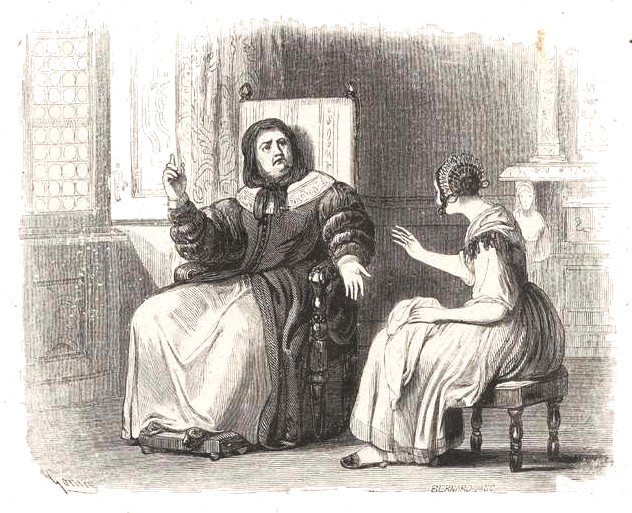
Donna Prassede and Lucia. Illustration by Francesco Gonin, engraving by Bernard, from the 1840 edition.
How many times over time have I said to myself “I recognize you, Donna Prassede!”. More recent studies have led me to think of another, more ancient figure, who stands behind, as in a watermark, all the Prassedes present and past, well individuated by Someone far more authoritative than Manzoni; it is Martha of Bethany. And yet, against all logic, this figure, Piero Bargellini recounts, has been indicated “to Christian women as a model of industriousness”. Let us try to explain why.
A curious dependency.
The premise is that it was the early years of the century and the streets of Florence were not yet crowded with beggars. I had happened, only that once out of curiosity, into an informal meeting of a very small and ephemeral aggregation of Catholics of the La Pira circle, and I was struck by the outburst of an elderly lady (she was of the closest circle of collaborators of La Pira) who complained of her difficulties in educating her little granddaughters in a Christian way, given that “in the city, of poor there are no more” — “unfortunately” she did not say it. I was surprised: but how, I thought, if by now even among us “daughters ride away on casual pillions” (see T.S. Eliot, Choruses from The Rock), would there not be matter for choices and Christian formation? And if the poor to be helped were so indispensable to salvation, how can one earn Paradise in the same way? I wondered. And again: might it not be that, no longer seeing poor around, the lady unconsciously fears she can no longer count herself among the rich?
Sermo 42.2.
Not many years later I realized that the mentality of the La Pira lady is among the ripe fruits of this Augustinian legacy:
If I found no beasts of burden nor ships to transfer me from the west to the east, where will I find the stairs to go from earth to heaven? God says to you: Do not be distressed! I who have made you rich, I who have given you things to distribute, I have also made the poor who are like your porters (Augustine of Hippo, Sermo 42.2. [N.B. The image of the poor as “porter” of the rich in his journey towards heaven occurs several times in the Augustinian discourses. (Ed.)]).
A legacy that is troubling, in fact functional to his adaptation to the needs of the ruling classes of an empire in decomposition and above all, over the longer term, to the development of homo œconomicus. End of recreation, of immediacy, of gratuitousness: everything will become anxiety, scruple, performance. The nexus (not the matrix or the cause) individuated by Weber between capital and religion does not find its origin in Calvin but in a more ancient Augustinian posture (his own, of Luther, Augustinian monk, of Calvin, of the Jansenists, always Augustinian), already fully operative in Western Christianity.
• Intentions.
Only a poet like Eliot could condense in one line — O Lord, deliver me from the man of excellent intention and impure heart (again from The Rock) — the result of this aspect of the Augustinian shift:8 the birth of beneficent organizations, deprecated in vain by Illich. In the Jesus narrative what stops the Good Samaritan on his journey is in fact not the intentio, proper to homo œconomicus and the result of his incessant calculations, but a motion of the heart. “He saw and had compassion” (Lk 10:25–37): pity, com-passion, empathy, not moral calculation. He bends over the wounded man, helps him, then leaves the money with the innkeeper and continues his journey. No institutions and charitable trades result from it.
• Either rich or poor.
Striking in the Augustinian reasoning cited is what we might call the disappearance of the middle class. Not foreseen is one who lives without great reserves nor great privations, yet there must have been some even in Carthage and Rome of the Fathers.
Only rich or miserable. (At times in patristics one alludes to “hungry” and “thirsty”, to absolute, material poverty). Why are the middle situations ignored, which perhaps represent the majority of the population? To clarify the mystery, perhaps René Girard can help us, with his theory of mimetic desire:
In Jean Santeuil, Proust's first unfinished novel, the author places his hero in the box of Madame de Guermantes, “arrived”, happy and triumphant. In In Search of Lost Time, Proust inverts his point of view, and places the narrator in the parterre, who contemplates with avidity the inaccessible object of his desire: the box of Madame de Guermantes. This inversion, revealing of the true nature of desire, gives the scene the depth and the literary dimension that were lacking in the corresponding scene of Jean Santeuil. In effect, the true experience of desire is that of lack, of humiliation and of the impoverishment of being [...].9
• The drug of the envied.
Somewhere, but perhaps he worked on it less, Girard also alludes to the complement of the desiring gaze. In the case, the gaze of Madame de Guermantes: it is the grasping of others' desire that valorizes our object and makes us enjoy it more. Indeed, more often (here is the inversion, the alienation) we will enjoy not so much the object (a box at the Opéra, perhaps we are deaf to music) as precisely the envious gazes.
In the envious-envied game there are no intermediate figures: this is the answer to our question. The indifferent one, the penēs — he who even when deprived10 accepts necessity and does not desire — is outside the game and therefore seen as an unwelcome, disturbing element, to be removed: if the envious lost desire, the envied would have sacrificed themselves for nothing, a terrifying disclosure for them, catastrophic. It is the perplexed silence of Alexander, who finds himself not envied by Diogenes.11
Girard's analysis allows us to see clearly how the Augustinian charitable economy functions in the practice of human relations and psychology: the good Christian rich felt called to educate these non-desiring ones, to transform them into ptōchós. Thus Don Milani, who has his boys build a concrete swimming pool to welcome them into the anthropological values of his family of origin, to make them accede to a surrogate of standard wealth. With equal spirit and praxis, that is, distributing tastings of wealth, the good Florentine ladies of the St. Vincent de Paul moved among their clientes,12 enrolled in the register of beneficiaries.
If I have a Rolex and no one envies it, it is worth nothing. If, charitably, I give ten imitations to the poor, turning as many individuals — previously indifferent to horological idols — into competent, envious ones, then my authentic Rolex gains in value. The system is simple, all in all, and it works. ¶ We note in passing that the rich person, if consumed by the anxiety of recognition, is in fact a wretched ptōchós: marked, too, by the manque, the constitutive lack. And it is precisely this that makes the autarchic penēs, as mentioned, so unsettling—to the point of intolerability, even hatred.
Hypotheses on Martha.
The Gospel passage that recounts Jesus' visit to Martha and Mary, in Bethany, tells us enough about the Augustinian manipulation tending to disarm by every means the Gospel of its critical contents. The text, which sees the translations fairly concordant, narrates a real and credible episode:
While they were [Jesus with his disciples, in other translations (Ed.)] on their way, he entered a village and a woman, named Martha, received him [into her house, in other trans. (Ed.)]. She had a sister, named Mary, who, seated at the Lord's feet, listened to his word. Martha instead was distracted by many services. Then she came forward and said: “Lord, do you not care that my sister has left me alone to serve? Tell her then to help me”. But the Lord answered her: “Martha, Martha, you are anxious and troubled about many things [too many things, in other trans., orig. Greek: πολλά (Ed.)], but only one thing is needed. Mary has chosen the better part, which will not be taken from her” (Lk 10:38-42).
We have two sisters of whom one, Martha, seems to participate in the psychological classification recurring here: the anaffective type (masculine or feminine), who often masks his incapacity for affective relation/listening/tenderness with a hyperactivism that aims at dominion over men and things and that rests on the continuous proclamation of states of emergency.
Realistically, the sudden arrival of Jesus, with other disciples, made necessary an activity for reception and perhaps the preparation of a meal, beds, in short work. But how much work? What meals? What beds? How much time necessary? Will nothing remain for an affectionate initial exchange/listening? Certainly not for Martha, who always raises the alarm of work to be done, precisely to flee relational and corporeal exchange. Her modus operandi foresaw a Jesus abandoned in a corner and the two sisters, with Mary at his service, only taken up with chores.
But Mary does not stand for it and lingers, in close contact, with Jesus. Then Martha bursts in (clumsily: a modicum of consideration would have required her to call Jesus aside and give him a scolding in a low voice—and, above all, to her alone), and first rebukes Jesus—it’s unclear whether for being indifferent to her hard work or even for being an accomplice to the idler—: “Don’t you care that my sister has left me to serve all by myself?”; then she commands him, “Tell her, then…,” to act as her messenger to Mary. Note that in the Gospels she is unique among his [followers] to use with Jesus the imperative in a truly directive way — and this she should not have done even with the least of guests: hospitality, in every code, imposes on the one who receives to serve, not to direct. Jesus, obviously, ignores the command, replying with that subtlety, that sprezzatura that Cristina Campo has noted: “Martha, Martha...”. We imagine him smiling and shaking his head; at times, as they say, one word is little and two are too many. And then, with affection, he corrects her explaining that it is she who errs when she insists on a bustling that is not there, well beyond the necessary. And what is not necessary, we know, is vanitas.
The account puts homo faber in question, this is so clear that the contemplative orders of the Church have always read it as an approval of theirs. Let us now come to the treatment Augustine reserves for this passage. It is in Sermo 104 that the manipulation, made also of cuts and additions, transpires with clarity. Augustine writes, in substance: “We know that you have seen that Jesus seems to reproach Martha. But let us not be deceived by the text. That reproach cannot be what it seems, that is a critique of service and charitable industriousness. Martha's action, consequently, is not erroneous: Jesus affirms that Mary has chosen the better part, but Martha's too is not bad, but necessary”. But this:
1. Deforms the text not a little. First of all it cancels entirely the most important words of Jesus: that Martha errs by worrying well beyond the necessary (“μηδὲν ἄγαν”, “ne quid nimis”, “nothing too much”, recommended the sage Chilon). In the Augustinian argumentation the service demanded by Martha is entirely transparent, objective, not in discussion:
Do we perhaps believe that Martha's service was blamed, all occupied with the tasks required by hospitality given that she had received as guest the Lord? How could she be blamed who had rejoiced in receiving such an elevated guest? If such a blame is just, let all then leave the service rendered to the needy; let each choose for himself the better part, which will not be taken from him, let him apply himself only to meditating the word of God, let him long for the sweetness of knowing, let him occupy himself solely with the science of salvation, let him not worry about who is a foreigner in his own country, who has need of bread, of clothing, of being visited, ransomed, buried. Let the works of mercy be eliminated so that one may attend only to the science of salvation. (Sermo 104).
Therefore it is the assumption that Martha's “service” is a priori not blamable that holds up the whole Augustinian construct. But to blame it is precisely what Jesus does, as moreover several times — even harshly and without regard — showing the egoic, narcissistic substrate of manifestations of pietas. ¶ One might say that Jesus himself is the first of the “masters of suspicion”: see Matthew 6:16–18 “And when you fast, do not look gloomy like the hypocrites, who disfigure their faces to show others that they are fasting. Truly I tell you, they have already received their reward. But when you fast, anoint your head and wash your face, so that people may not see that you are fasting”; Luke 18:10–12: “Two men went up to the temple to pray: one was a Pharisee and the other a tax collector. The Pharisee, standing there, prayed to himself: ‘O God, I thank you that I am not like other men—thieves, the unjust, adulterers—or even like this tax collector. I fast twice a week and give a tenth of all I have.’; up to the terrible “Woe to you, hypocritical scribes and Pharisees” in Matthew 23. However, take note: this revelation concerns not only hypocrisy but also a cognitive distortion: Matthew 6:23, “If your eye is bad, your whole body will be in darkness. If then the light within you is darkness, how great is that darkness!” ¶ Augustine's discourse claims the unquestionability — not of the gesture of the Good Samaritan, nor of the first communality of the Christians of Acts, but of the real rich-for-porters organizations justified in Sermo 42.2., in which the phenomenon of the necessary Girardian envy was certainly visible to a non-myopic gaze: the ancient rules of the Misericordia of Florence required that, in the course of their compassionate service, their faces be covered by a hood—the buffa—precisely because of that danger.
The danger was real, it was recognized, and it was countered. Augustine sees in the Lucan passage on the two sisters a threat for the world of the Prassedes, and of Monica? I believe so.
2. Adds to Jesus' words a distorting qualification that is not in the text: «The part chosen by you is not bad, but this one [chosen by Mary] is better». Jesus says nothing about Martha's part, and above all does not qualify it as good or necessary. The ἀγαθὴν μερίδα is the one chosen by Mary; Martha's could be only a little less good, or even harmful (one thinks of Snow White's apple).
3. But there’s more: his commentary, by distorting both the account of the rebuke and the meaning of Martha’s complaint, renders it incomprehensible and neutralizes it. Martha a) rebukes Jesus and orders him b) to rebuke Mary because wasting time when there is work to be done is wrong and deserves censure. How does Jesus respond? With the fine sprezzatura initial (“Martha, Martha... [you do not understand...]”) that prepares the subsequent teacher's tone: overturning completely the roles proposed with so much vigour by Martha. Let us observe, in passing, that both her — Martha's — behaviour and her reasoning are bad: if Mary has chosen the better part, the greater good, proposing to reproach her precisely for the choice is in itself bad. All this is obliterated in the brilliant but artificial construction of Augustine.
That the obscurity of the Gospel passage for Augustine—his failure to perceive the evidence presented in the narrative and the suspicions of Jesus himself—is amplified by the parallels between the figure of Martha and that of her mother, Saint Monica, remains a hypothesis, while it is certain that Augustine’s lectio facilior was successful despite the weakness of his argument. Piero Bargellini repeats it pedantically, for example, in his successful I santi del giorno (Vallecchi, 1958):
The amiable reply of Jesus can sound like a reproach to the industrious housewife: “Martha, Martha, you are troubled and anxious about many things; only one is necessary: Mary instead has chosen the better part, which will not be taken from her”. But a reproach it is not, comments St. Augustine: “Martha, you have not chosen evil; Mary however has chosen better than you”. Nevertheless Mary, considered the Gospel model of contemplative souls already by St. Basil and St. Gregory the Great, does not seem to figure in the liturgical calendar: the sanctity of this sweet figure of woman is beyond discussion, since it has been confirmed to her by the words of Christ themselves; but it is Martha only, and not Mary nor Lazarus, to appear in the universal calendar, almost to repay her for her solicitous attentions towards the person of the Saviour and to propose her to Christian women as a model of industriousness.
The proposal of Martha as “model of industriousness”, still undisputed, is the bulwark of the Augustinian operation of overturning: as if Saint Peter were proposed as a model not for his martyrdom, but for his denial. ¶ Does Augustine, I propose, see Mary through his mother’s eyes — how would that illustrious acquaintance of hers have judged her? Let us say it: as a lazy, feckless woman, unlike the golden, provident Martha a. If only there were more like her! Jesus, vice versa, in substance tells her “Mary has seen well, you not”, and addresses her with “Martha, Martha...”. Compare the iteration of the name with “Simon, Simon, behold Satan has sought you...” Lk 22:31 and “Jerusalem, Jerusalem...” Lk 13:34. A most elegant way to qualify her as blind, obtuse.
Against Augustine. Synthesis in accusatory form.
1. He overturns the epochal opening of Jesus to children: : “Unless you … become like little children” Mt 18,3 — which had removed them from invisibility to put them even at the centre, proposing to welcome and imitate them — with a negative vision of childhood, anticipating the Lutheran expulsion of children from churches as well as Freud's “polymorphous perverse” child, today declining.
2. As shown above, he neutralizes the Gospel passage about the sisters of Bethany, obscuring Jesus’ criticism of Martha’s blind activism.
3. He imperceptibly diverts the gaze from the poor, example and goal — the frugal, active and free penēs of Jesus' own family life, of the Sermon on the Mount and of the episode of the rich young man — to the miserable ptōchós, beggar and dependent, proposed as an instrument of salvation for the rich, no longer a person: example and goal becomes the munificent rich man.
4. He is the codifier of original sin as hereditary guilt and the promoter of the doctrine of radical predestination.
5. Prudently orthodox Christianity has avoided Western Augustinocentrism: whoever instead assumes Augustine as Master does not simply adopt an author, but an entire anthropological proposal and posture.
6. Lutheranism, Calvinism and Jansenism — so functional to the leap of a millennial and universal process that occurs precisely in the West and whose specificity remains largely unexplained — not only descend directly from his thought, but carry its most proper implications to completion. A continuity well visible and known to specialists, but never thematized.
7. The category of “Augustinism” — which designates not so much a theology as an abstractive and redemptive anthropological structure well ancient, here outlined in broad strokes through the reading of Luke 10 and some observation on philanthropy without φιλία — possesses therefore a heuristic capacity that proves more fecund than the traditional one of “Protestantism”. It helps in fact to understand how the West was the fertile terrain of what Karl Polanyi called the “Great Transformation”, avoiding at the same time an artificial chronological caesura (16th century) — incapable of recounting the extraordinary concentration, already in the Crusades and in the boom of cathedrals, of an auriferous mass anxious to circulate, produce and grow.
8. The premises are perhaps already in a possible reading of Paul, but Augustine is the first great systematizer. For this the special conformance between religious posture and the historical unfolding of capital (a practically universal movement and visible for millennia), individuated by Weber in Calvinism, must be backdated: the hypothesis proposed here is that that anthropological curvature was already fully operative in Western Christianity with Augustine. Calvinism does not open a new phase; it constitutes an internal development of the same trajectory. Augustinism informs, though contested, Catholicism and Anglicanism, fully Calvinism and Jansenism and in a more tempered way Lutheranism and a great part of Protestantism; it is instead uninfluential in Orthodoxy, in apophatic mysticism, the Quakers and others. In Catholicism it will represent a permanent internal contradiction of Thomism, from which sprang, as an attempt to liberate itself, Molinism. The choice of mendicity — of the ptōchós not of the Penētes — and consequently of dependency on the rich, made of the Franciscans — That's dialectics, baby! — the supporters of a profound Augustinism, but on the side of the porter: Franciscan scholasticism (Peter John Olivi at the head) is protagonist in the legalization of usury around 1300. For a collocation within the complex historiographical debate see appendix 3, “The Dates of Capital”.
The barbecue of the Risen one.
A curious and almost moving Gospel scene (in the “Second miraculous catch”, John 21:1–14), surprisingly almost absent in art and preaching — the Jesus who roasts fish on the grill of James Tissot's watercolour is, in all probability, a unicum — offers a radical counterpoint to this line. The Risen One, appeared at night on the shore of the lake, finds the disciples, confused, returned to fishing, empty-handed. He does not reproach them, does not spur them to a new activistic enterprise, does not invite them to restructure their existence. He says simply: “Cast the net” and in the morning, when the miraculous catch concludes, “Bring some of the fish you have just caught”, he had already prepared the embers to roast it. “Come and eat”. It ends almost like an Asterix album with the whole village at table, toasting and singing. In the passage something manifests that Augustinism has removed from Western Christianity: the joy of the Simple. That morning on the shore of the lake there is not the anxiety of Martha's emergencies, there is not the torment of a Donna Prassede who confuses her brain with heaven, there is not the poor as providential porter for the salvation of the rich. There is instead the redundant enjoyment of the certainty of Presence, the joy of the Simple — letting-be, quàia, wu-wei — carnal and convivial. Perhaps the representation of a risen Jesus who, after gutting and probably seasoning the fish with aromas, prepares the embers, blows on them, arranges the fish on the fire and turns them during cooking, was disturbing, too little spiritual. Better to avoid it.
James Tissot, Repas de Notre-Seigneur et des apôtres, 1886–1894, watercolor.
Appendices.
❶ Premises and origin of the above.
At the origin of the present work there is not a reading nor a theoretical hypothesis, but over fifty years of observations. Coming from a working-class background — grandparents and some uncles peasants, father and other uncles workers —, I found myself, little more than twenty years old, living stably in Florentine urban environments that presented themselves as superior in class and lineage. I inhabited them without fully belonging to them, observing them from the threshold, encountering not a few persons, families and vicissitudes that only many years later I would recognize as manifestations of a single pattern, in its negative consequences mild, consistent or sometimes tragic. For decades I had no language to name them, but they continued to interrogate me. That language began to emerge when I encountered the fragment of a conversation with Jacques Camatte in Milan in October 2012. Jacques spoke a particular Italian: learned in his youth with the Bordighist workers of Marseille — who had left Italy during the twenty years of Fascism — and then consolidated with Bordiga himself. Many years later he still spoke it with the difficulties that faithful transcription does not conceal. I was not present, but I immediately had knowledge of it thanks to my friend Riccardo De Benedetti, who shrewdly recorded a part of the encounter with his mobile phone and, knowing of my longstanding interest in Camatte, pointed it out to me. I took years to fully understand its implications, helped by the reading of the research that the author conducted in his last forty years. This oriented the research on the themes developed in the trilogy. The developments, the applications and any errors remain naturally mine.
[...] Instead [I agree] with Amadeo, whom I find very important because what I felt in my youth in an important way was certainty. And for me if there is no certainty there is no life, because I am not, as it were, tied to the total process of life. The total process of life not only of the organic sphere as we see it on our planet, but the process of life of the cosmos. Because everything is life. Everything is born, everything disappears, everything is change. And to feel this is not [to feel] like Blaise Pascal who had a tremendous fear of it, but it is an enjoyment. Instead he was precisely the child and it means that he had not been recognized, precisely in his being, by his mother and father. He said: the silence of these infinite spaces takes hold of me, makes me afraid. It means that I am not recognized by space. Indifference. But what is the fundamental support? It is a psychic support, it has not been recognized. And indifference is precisely the most tremendous thing. It is better to be considered an enemy. Indifference is worse, perhaps contempt. Because it is a form of recognition that denies you. Incredible. And therefore this invariance, at first it gives me a joy and in a certain sense I agree with Spinoza, joy is the... [laetitia?], but he finds the word also French [probably béatitude or allégresse], it is also stronger than joy. Now I do not remember. Therefore this is the importance, this is the joy, life is joy. It is the enjoyment of living, otherwise if there is no enjoyment there is the void. And then this happens precisely when I need to fill everything that happens and I find myself with time. In this regard everything that Saint Augustine writes on the question of time is extraordinary. And one sees the child who depends... He says, where does time come from? But he says, for example: time; the past is what has happened and which presses on me; and the future is what is awaited. Therefore he is always waiting. And what is terrible is that time comes from the future, it means that he is always in the expectation of receiving everything that he must receive from a mother or a father. Instead if I accept my child in his naturalness, in his spontaneity, in his completeness, in his immediacy — insofar as he is not me, but is truly in my biological continuity — then yes he can no longer have need of the creation of a time to give a framework to his life. But this problem of time is extraordinary. ¶ And when one knows a little of his life and then the life of his mother Monica who was truly…. She managed.... Let us say, Saint Augustine is a pro — Let's just say that St. Augustine is entirely his mother's creation, and that's incredible. I'm not saying this to speak ill of mothers or women, but… (2012 Meeting in Milan with Jacques Camatte).
❷ Precisions and digressions.
From our summary biographical investigations some characteristics have emerged, not general, that we wish to point out to whoever might want to go deeper. The first, notably in the cases of Sartre and Montale, is a life under the sign of a continuous and directive feminine presence together with the absence of masculine friendships among peers. The second is the initial, failed attempt to aim at the biggest prize, in the field of the most abstract and incontrovertible genius, mathematics. Leopardi, Musil, Michelstaedter are the cases.
The fact that the name Blaise Pascal—which appears several times in this text—does not appear in the initial table allows us to clarify something. In his case, all the boxes would have been marked “Yes” except for the first one. The second one would also have been marked “Yes”: his mother, Antoinette Begon, died when Blaise was three years old, an age—according to Winnicott—at which affectivity, or its absence, has already left its mark; in Pascal’s case, that mark is clearly visible in the data, and it indicates a lack of affectivity. But our investigation, as already explained, focuses on a specific subset, and the first box should have contained a question mark: we have no information about the mother regarding the characteristics that interest us (lineage, nymph status). As for the rest, Pascal would have been in good company: his older sister Gilberte notes in her Life of Her Brother: “He could not bear the affection I received from my children; and he would tell me that I had to wean them from it, that it could only harm them, and that one could show them tenderness in a thousand other ways.” It was these ideas—characteristic of the moral climate at Port-Royal, of which Blaise was one of the leading figures—that also shaped the appalling treatment meted out to the children.
The Simple is the immediacy of experience, not its pleasantness: it encompasses joy and peace just as much as death and conflict. Its opposite is not suffering but mediation: the spectator’s gaze, repression, the fear of contact, and compensation. The notions of “vision of the Simple,” “access to the Simple,” and “amputation” should not be understood in a Boolean sense. The apt metaphor is not a light switch, but vision: from those who enjoy clear vision to those who see blurrily, to those who can barely distinguish light and shadow without recognizing faces, down to those who perceive only a vague luminosity. Amputation, the opposite of access, is a degree: in the table, it indicates cases in which access falls below the threshold. ¶ “Simple” does not refer to doctrinal content or a moral judgment, but to the capacity to participate fully in elementary, common, and carnal experiences: friendship, affection, play, fellowship, necessary work, walking, conversing, lingering, and the relationship with plants and animals; as well as participation in trials—one’s own and others’ grief, struggles, war—not for the trials themselves but for the full and shared presence one offers when engaging with them: it is the brotherhood of the trenches that veterans long for. It does not matter whether an author approves or disapproves of these elementary experiences: he may mock them and yet live them to the fullest; what matters is the genuine access he demonstrates. ¶ Furthermore, this amputation does not equate to ignorance of the existence of the Simple. Those who feel excluded from something they have never fully experienced may be obsessed with it and describe it with insight, drawing on what they have read and heard, on desire, and on imaginative reconstruction: Leopardi from the window. Speaking of it is not enough to prove that one inhabits it, and the difference is sometimes visible in the way one refers to it. First-person experience in the present tense—embodied and unmasked by irony (Montale’s “Gina” in his final poem)—attests to access. A reference made from the perspective of a spectator (Leopardi peering out the window)—expressed in the conditional tense, projected into a mythical past, or presented as a mere ideal—attests to a lack of access. A single reference of the first type shows that the author has a certain degree of access; the absence of such references does not prove a complete lack of access: it merely justifies not attributing access and seeking clues of that lack elsewhere.
The particular conformance here enunciated — on the basis of Weber — of Augustinism with the growth of capital must not be read as an immediate and subordinate product of capital, or of the process of abstraction, understood as super-subjects. These are visions with a purpose of their own: to temper and harmonize social differences, limit the excesses of the psyche, give order to a world perceived as threatening. Visions that arise from a wounded perception of reality and relationality, filtered by experience and by familiar, cognitive and affective language, and which, by structural affinity, reveal themselves functional to the expansion of the dominion of capital and of the technical system over human becoming.
The husbands (and fathers)? Even if not mentioned in the initial table, the investigation on the illustrious figures and on those of the experiential archive poses the question by itself. Let us try to answer. Faced with such a wife, at a first reflection three type behaviours are individuated, often adopted two or all together:
Submission. In analogous cases Wodehouse proposes the formula “no longer masters even of one's own soul”, adding that nevertheless once it is decided who commands, things work. Manzoni certainly places in the category Don Ferrante, spouse of Prassede: “handing the draft to be copied to his consort, he warmly recommended spelling to her; which was one of the many things he had studied, and of the few over which he had command in the house”. I would certainly place here Monaldo Leopardi: his refusing the proposal to assume command of the anti-French revolt in the Marches could also be a sign of a certain lack of courage but probably the reason was less dramatic: simply Adelaide did not give him permission.
Permanent war. It seems the case of Hermann Kafka. Not the least destructive, for everyone.
Flight. Perhaps the most frequented. The distancing from the toxic situation, from the trap, is the most natural behaviour, and also fruitful insofar as it is an example for the children. At times it assumes part-time modalities, what one calls making a figure for oneself and consoling oneself — with work, with others, but in any case elsewhere. At times it assumes the character of explicit desertion, disappearance: literary model I would say Lord Marchmain of Brideshead Revisited, by Evelyn Waugh.
Someone has seen this text as a manifesto, à la Tiqqun — whose environment also cites Camatte, although its matrix is rather Benjaminian. If anything an anti-manifesto, which investigates the psychic origins of manifestos themselves. For Tiqqun, redemptive already in the name, its Bloom is not a pathological form of man, but the last of an infinite series of monsters observed by the backward Angel in a time, all time, not only that of civilization, made only of ruins and evil. The classic eschatological structure: if history is integrally ruin, the last monster can open the paradisiacal redemption. In the Angel's vision, the Simple — that of yesterday, of today, of always until extinction, that of Heidegger's Feldweg, which Camatte calls immediacy — is not only obscured but, insofar as it is life ontologically not domesticable to ideal perfection, becomes imputable, hence in need of overcoming; and therefore included among what must be destroyed so that the (magic) awaited insurrection can finally redeem everything. Revolution and insurrection thus become, as always, the name assumed by the leaps through which capital dissolves the social configurations that limit its deployment. “We call capital the movement that abolishes the present state of things” (Pseudo Marx, from mtap).
A recurring theme not listed in the table is the attempt to escape. ¶ Augustine: first, Manichaeism, as a way out of his mother’s Christianity; then, his departure from Africa for Rome and Milan. These failures brought him back, through Monica and Ambrose, into the fold. ¶ Leopardi: his escapes to Rome—the dream of an elsewhere where women “give themselves” (letter to his brother Carlo dated December 6, 1822) and where one gains access to the Simple and the adult tribe—fail and reinforce his withdrawal. ¶ Bazlen: the escape recommended by the psychoanalyst is carried out on a material level (he does not visit his mother; he sends “friends”), but it does not sever the psychic bond: once again, it falls short in what matters most. ¶ Perhaps Thomas Bernhard as well: his entire body of work is an escape that never takes off—from Austria, from his mother, from the provinces, from “stupidity.” His travels and stays abroad, and his very style—the uninterrupted invective—are forms of distancing that never resolve into a true departure. ¶ Simenon succeeds, and he recounts it; in fact, he is not on the list. ¶ A complex interaction between force fields: nonlinear, unpredictable in its details, but real, as demonstrated by the three-body problem, where known laws are not enough to predict the outcome.
❸ The dates of capital.
• In extreme synthesis.
Where the circuit M→E→M' is given — M stands for Money and the final apex indicates its increment, the surplus value — one is already in the presence of capital. E stands for any activity that takes the name of Enterprise. It is circulation: M leaves the till to finance an enterprise in order to return to it, probabilistically, increased: it is this risk, known, that gives the name of enterprise to the activity. Let us list the best known: loan at interest, defence-conquest-war, insurance, corruption-lobbying, intelligence-deception, commerce, production-construction, pimping, spectacle, agriculture, medicine, hunting and fishing, art, care of souls and psychism. Many of these activities are prior and not necessarily correlated to capital, but when they become so this transforms them progressively. ¶ The self-growth of money (money=real abstraction of value, according to Sohn-Rethel's proposal) is not the result of a “mode of production” that emerged in the 16th century, but a transhistorical parasitic “algorithm”, operative well before coinage (as Aristotle already grasped in chrematistics). Classifying its ancient manifestations as “formal” and postponing to a “real” era is a blind alley inherited from Hegelian constructs: the reading of pathological proliferation does not consider ontological passages, but only differences of magnitude and adaptations of the host (as in oncology: from tumour T1 to metastasis). From the origin, M→E→M' behaves as an automatic subject: a field of forces, born and living from the mind and from the social relation, which reacts back on the human psyche irradiating images of power, pleasure, immortality.
• On the birth of “capitalism”.
The figures in the Gospel already inhabit a world of money, banks, interests. The vain invitation of Jesus to the rich young man not to occupy himself with money would have produced stagnation and weakening of circulation, famine for capital. Augustine’s invitation to the rich to busy themselves ‘helping’ the poor — which implies occupying oneself with wealth and increasing it — was received with success, and develops capital and its grip.. Setting aside the vexata quaestio of the modes of production and their dating (not to speak of the “Taylorism” already active five thousand years ago in the Giza worksite) let us concentrate instead on the historical and omnivorous growth of capital. The mode of production is a transient social configuration, which, among other things, lives interacting with other different ones; capital is a dynamic of valorization. There does not therefore exist a “capitalist” mode of production: the dynamic of capital consists in progressively dissolving every mode of production, even those that its previous deployment had made possible (already in the Manifesto the formula of the bourgeoisie that must continually revolutionize the relations of production conflicts with the idea of a “mode of production” — and of a class — as a stable form, and Marx in the Grundrisse appears aware of it).

Notes.
1 See Hillman, Essay on Pan: if the myth remains imaginal, the encounter is a psychic event; if it is acted out, it is pathology.
2 See the notable: Gerardo Muñoz, The necessity of Penia, infrapoliticalreflections.org, May 31, 2025.
3 See TAG8. Studio sulla scomparsa del Tempo Autonomo Esterno nell'infanzia e le sue conseguenze (A Study on the Disappearance of External Autonomous Time in Childhood and Its Consequences), Le raccolte del Covile, 2023-2024.
4 See further on the observations on the “knife dripping with sauce” of Hermann Kafka.
5 Monaldo's younger brother, Vito (1770-1850) married in 1812 Olimpia Melchiorri, widow Basvecchi, who thus became the poet's aunt. She must have been a living person in that House of Usher in which Giacomo grew up, as certainly was Silvia (Teresa Fattorini, daughter of the coachman). But for Olimpia we have no poetry, she was in the house, carnal, not an idea: a danger for the defensive walls.
6 We are comforted in this hypothesis by the fact that Charles Fourier too, in his utopian reveries on the phalanstery, registered “l'amour de la saleté” as a passion proper to children.
7 One could cite, as an unsurpassed humorous counterpoint, the patronesses of The Good Soldier Švejk, lavish with devotional trinkets, whose marvelous roast chickens bring suspected malingerers a punitive gastric lavage.
8 This modality of removal was classified with precision by Jacques Camatte as *détournement* in his indispensable Glossary.
9 La frusta letteraria, www.lafrusta.net, summarizes thus a text by Girard himself.
10 For Heidegger, what defines Poverty is not lack but the acceptance of the limit.
11 Incidentally we note that, in Plutarch's account, Alexander is driven by the same solicitude as our serial philanthropists: "the monarch turned to him greeting him, and asked if he wanted anything, Diogenes replied: 'Yes, stand a little out of my sun.'" There also comes to mind one of the pestiferous Wodehousian boys: “It occurred to me that this Edwin was one of those who do not spare themselves, and, like his sister Florence, was seriously engaged in life, as he had amply demonstrated since he had entered the boy scouts. Not wishing to shirk his responsibilities he had conformed with ardent and resolute spirit to the rule of the daily good deed, but, unfortunately, between one thing and another, he always remained behind and never managed to accomplish it regularly, so that whenever he glimpsed the propitious occasion, he threw himself headlong, trying to catch up with whoever happened to be within reach, rapidly transforming every place he found himself in into a perfect hell for men and beasts. (Joy in the Morning)".
12 The Latin term clientes is not used here as a boutade but individuates an important and timeless sociological figure: persons (better if of regard, but in any case in great number) whom you gratify/remunerate because, envying you, they corroborate you in your identity.
www.ilcovile.it
Wehrlos, doch in nichts vernichtet
Inerme, ma in niente annientato
(Der christliche Epimetheus
Konrad Weiß)